Fusions in the Void, Part 1: What are “Fusions in the Void”?

Some years ago I built an artsy coffee table with walnut, maple and a marble top. It also has a drawer. In the bottom of the drawer, covered with plexiglass, sits a piece of paper with fifteen written lines, the first of which (reading bottom to top, seeing the first line as you open the drawer) is “Fusions in the Void:”

I covered the plexiglass with sand, added some pebbles and made some small rakes out of copper with wooden handles, and a tiny hoe as well, so that, to uncover the words underneath one must rake the sand aside, a sort of zen garden tucked in a drawer. The contemplative exercise allows for discovery of the lines, hidden in a similar way to how things are hidden when we experience Void in our lives. This Void has other names: the Dark Night of the Soul, or a Valley Experience. It’s thought of as not only a spiritual but also psychological phase which includes depression and a significant sense of spiritual disconnection, but also can be a time of simplification and purification as well — depending on how you engage it.

In a move of pure hope, (because I was in such a Void when I made the table) I decided that surely in the Void some things were also fusing. It’s a sort of spiritual cold fusion, more based on a hope than a science.

Scientists talk of “pathological science” as a scientific pursuit of something which has been proven not to exist, or of “the science of things which are not so.”  Cold Fusion, the idea that fusion energy could be produced at room temperature, is one example. People keep researching it because there’s some sort of hope that it could be, though scientists have proven it’s a thing “which is not so”. Richard Feynman talked about “cargo cult science” where people do things scientifically in the same way that South Pacific Islanders attempted to bring planes full of cargo back to their island by creating air strips complete with a hut with a home-made air traffic radio man inside it, complete with a headset, made of balsa wood, basically the cult creates all the trappings they’ve observed of an airport but it does not deliver airplanes. No cans of Spam arrive with obesity ensuing.

I suspect that hope must seem a pathological thing during the Void, and that even the trappings of spirituality seem like a cargo cult. We pray and journal and fast and pray some more, we read the Bible, and the harder we try the more God seems distant, as though on a journey or indisposed. His airplane never lands on our airstrip. What are we doing wrong? Where is the God who lit Elijah’s offering in a second? Where are the cans of spiritual and psychological Spam we wanted?

Hope, however, was David’s pathology all through the Psalms. “Why are you cast down, O my soul, and why are you disquieted within me? Hope in God, for I shall again praise him, my help and my God.” (Ps. 42:11)

I like David’s use of the word “again”. It is as if to say “someday” as well as, maybe, now, as if to say “even though I don’t feel like it now, I will come back around to it eventually.” My friend Tim told me that in the newspaper office where he used to work, the standing joke was that any headline could gain added depth or at least humor by adding the word “again” to the end of it. “Mayor caught embezzling money– again” or “Eagles fall by a score of 52-0 to Panthers, again.” There’s power in that little word.

Part of my hope at the time I made my table was that in spite of the Dark Night or Void, when I had a deep and pervading sense of spiritual and psychological blindness, that there was some sort of Fusion going on, a cold fusion perhaps, when you’re neither hot nor cold, you’re just at this tepid room temperature, virtually numb, feeling little, groping for solutions. Living in fog as thick as pea soup (an image that has stuck with me from the children’s book Cloudy with a Chance of Meatballs). But in that fog, there’s a hope that fusion will happen in our lives, again.And perhaps even now that fusion is happening, though unseen.

Cold fusion may be an impossibility in the world of physics, but in the spirit/psych world of the Dark Night or Void, I am happy to pathologically believe that fusion is happening.

I invite you to follow a series of 14 more essays on Fusions in The Void. I’m sticking with the Void idea (and will not clutter future essays with the other terms) because it’s a place of creativity, of creation. I invite you to the paradigm shift that we are experiencing Void, not, perhaps in the sense of Eastern Mystics, but in this sense:

“In the beginning, God created the heavens and the earth. The earth was without form and VOID, and darkness was upon the face of the deep; and the Spirit of God was moving over the face of the waters.” (Gen 1:1-2)

What happened during a time covered in darkness? Two verbs: creation and motion. The combination of these two verbs happening together is the idea I call fusion. (By the way, we need to pay attention to the fact that the motion here is not particularly directional! Think of it more like the motion happening when your stomach is growling: a churning and digesting motion.) The following essays (which, on my blog will bear titles beginning with “Fusions in the Void, Part __”) will explore what may be created in the Voids we experience from time to time. It is my hope that you will take this journey of pathological hope too, and that, in the end, you would find that this is not a cargo cult activity, but ultimately a productive one. Especially if you’re in a Void, I urge you to come back and read more of these Fusion essays … again.
Congo Follow up — Culture Shock

On the plane ride into Chicago on 9/14 I talked with a young Congolese woman, 21 years old, on her way to the States for the first time to study at Northern Illinois University (crash course in English) with a goal of landing at Bethany Lutheran in the Twin Cities to study environmental science, with the hope of going home to give her government some ideas for how to clean up Kinshasa (smog and trash everywhere). It’s a daunting task.

Even before she lands the culture shock begins. She is given a meal but isn’t hungry. An hour later she hands the tray, untouched, back to the flight attendant. She turns to me and says “they’ll give it to the next person, right? Or will they throw it in the trash?” Sorry, kid, they’re going to throw it in the trash. In fact, you’re going to see so much waste it’s going to sicken you. We don’t leave trash all over our cities the way they do in Kinshasa, waiting for the rains to wash it down and out to the Atlantic through the Congo River, but we do waste a phenomenal amount of food. There’s no concept here of taking what’s left on your plate and giving it to a sibling or neighbor to make sure nobody goes hungry.

But after beating myself up for a while on all the crappy things Americans do (I’m grieving for her ahead of time thinking of all the ways she’ll find American hubris to disgust her) I realize that we’ve got a lot going for us, too. “I’ll get a very good education here, won’t I?” she asks; this is paramount for her. Yes, I concede, you will get an excellent education! As we cruise into Chicago I point over to the roadways, I-90 and I-294 around O’Hare airport. Immediately she sees that “they’re very well organized!”

A trip to Congo affords me the opportunity to see clearly those things in our culture that are good and bad, even though it’s only 10 days, and though it mostly entails stuff I already know.

Congo Photo 1

IMG_2595

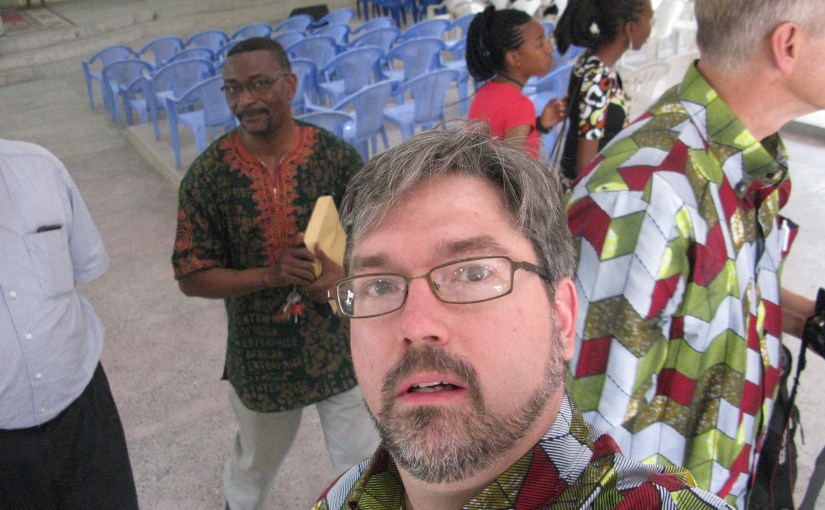
Selfie with Leonard Kiswangi (my primary translator for the training in Kinshasa) standing in the background. His two daughters are pictured, as well as Charles Buller (in matching shirt).

This was taken after church at Leonard’s congregation on Sunday Sept. 14.

Long Voyage Ahead

The invitation stands to come back to Congo again. When? Who knows. We can hope it will be as soon as next year.My bags are packed and in 90 minutes or so the company called “Jeffery Travels” will send a minivan to take me and Bill to the airport. We anticipate a two hour traffic jam followed by three hours at the airport, multiple checks of our baggage, and I’ll be back in the friendly skies by 10 PM.

On the way here I enjoyed the sparse scenery of the Sahara Desert and the Alps around Geneva, Switzerland, caught a few glimpses of Belgian Countryside on the way into Brussels, and saw Brazzaville and the Congo River at dusk.

Bill will be flying on a different airline, so my homeward bound adventure may not consist of much besides watching a movie or two, listening to a book on Kindle, and eating weird things. My health has been good almost the entire time (my stomach didn’t feel to great yesterday) and I’ve really enjoyed the people I worked with.

We’re just short of the rainy season, I think if we stayed another week I’d probably get rain, even now we feel the humidity beginning to come on.

What’s next? I guess we’ll find out pretty soon because I don’t have a whole lot lined up. I hope to be able to coach a few of these Kinois as I’ve been training them, and we’ll just have to see about the rest.

Los Tres Mundeles

Today was a rest day, a little opportunity to walk downtown with Bill and Charles between 10 and noon. There are pictures on Facebook now.

They are pretty great guys to hang out with. As soon as Bill got back from Kikwit last night we started joking around. His bus made good time and we were glad to see him.

So we went down to the same central area that I blogged about last night; where there’s a perpetual traffic jam. The traffic wasn’t so bad this time; it was day time for one thing. Along our route, we stopped to grab a Coke, then followed Charles down to the river. There was a checkpoint (guarded by two men and three tractor tires, set upright across the space) and Charles wanted to see if a friend of his who runs a fish farm right down on the river was home (the reason its a checkpoint is simply that the river is the border, and if you go down there and find a boat, you could go unguarded over into Congo. The friend wasn’t home and after a bit a woman came up to meet us, but as the man nor his sons were around, Charles said he’d come back later. In the interim, as we were waiting for her, Charles said, everybody’s asking questions here. Charles knows some people, but what has he brought two other mundeles? What is Mundele number two carrying in a bag? [probably millions of dollars] Why is Mundele number three wearing a yellow baseball cap? Are you sure they aren’t Chinese? What do they want?

So we moved on to the square, where Bill was hoping to send money over to his translators in Togo [uh, btw that’s another African country] and the bank he wanted to use (same bank as the one in Togo) turned out not to be a bank at all but just an ATM machine.

Then we went looking for Pastor Birakara Joli, the Veep of CMCO (Mennonite Congolese Church) who attended our training last week. Joli wasn’t home, but we knew it would pay relational dividends because word would get to him that three mundeles had visited his house.

Then we bought two pineapples.

Then we bought some little doughnuts.

Then we bought bananas.

Finally, carrying the makings of a fruit salad and eating the doughnuts (beignets — pronounced more like bay-nyays) we stopped at the Facebook Restaurant.

Funny thing about Facebook here: it’s very popular because with most cell phone plans, you can get a call but not make one if you don’t have pre-paid credits at the moment, which is pretty often. But you can use Facebook for free. The other thing about phones: they create jobs! Here and there are charging stations where you can plug in for a fee. Someone tends those. Then of course there are ubiquitous little umbrellas where you can buy credits, and of course you have to buy a phone now and then too.

So, Facebook for free with your phone plan is a big deal. Selfies abound. People I’ve friended have liked every single post. You can use it without paying for additional credit and you can use it as a texting service. That’s why it makes total sense that a Facebook Restaurant, very modern interior, serves schwarmas and burgers at prices few can afford (I got a schwarma for $4, but Zuckerberg did not get a piece of that action). We sat on a little wall, three mundeles in a row, on a curve in the road, eating our schwarmas, laughing at the fact that every bus that went by was full of people snapping photos of us with their cell phones and laughing at us.

Los Tres Silly mundeles eating in the sun!

Did you notice that none of our three errands were accomplished? I barely noticed myself. In fact, just by going in person and leaving word that we had been there, we built relational capital, and that’s an accomplishment in itself.

The rest of the day was a wash. My stomach did not feel well. I can’t imagine why. Street food in Kinshasa. Mmm-mmm good.

Traffic Jams: Congo Day Eight

Last night I went with Jacques for a walk after dark. I keep my eyes on the ground. The sidewalk (if you can call it that) runs beside a paved trench three or four feet deep and two or three feet wide. It runs downhill toward the river and is for sewage to flow and a pretty sure ankle-break if you step in it. Not to mention going home with your shoes covered in crap. The city teems with energy, the Kinois working late or shopping or going home or whatever else people do when the night is young and their stomachs are not completely full.

Jacques has been using my belt for two days — he had to punch an extra hole in it about eight inches tighter than the tightest hole I have. I’m about 38 inches at the waist, Jacques is probably 26. As we find the intersection Jacques says it’s full of people still at 2 AM. I don’t doubt him. It’s now about 8 PM and looks like if you wanted to get your car through this particular intersection it could easily take you six hours to cross a space about seventy-five yards wide. Forty-five minutes is probably a more reasonable amount of time.

There are no rules of the road to speak of, yet somehow people get where they are going. Eventually. The intersection where we end up is a beehive of people. It’s hard to tell from any single vantage point around the intersection how many roads feed into it. Cars blow down roads nearly empty until they come to an intersection like this one, and then wedge in. It is, without a doubt, the worst traffic mess I have ever seen in my entire life. We walk through the cars to the other side and turn. I stop for a moment and turn. I think he wanted to show me the big store behind my back. I barely glance inside, but there are things in well-lit stainless-steel cases, like slices of cake, perhaps like a bakery in another city eight hours flight to the north. It might be a full-on grocery store with all kinds of European items like Toblerone, but I pretty much ignore it. In my pocket is perhaps six dollars in local currency. I am not sure it would buy anything inside. If Jacques is hoping for a treat, he sure doesn’t say anything (it was his idea that I bring money for a taxi ride home, but I feel great and don’t mind keeping the money and walking back. There’s sort of an assumption that whites can’t walk far, and I’d be happy to defy that.)

Looking at the crowd instead of my feet, standing still in front of one of the most modern stores in Kinshasa, I finally catch a vision of what this place is. It’s une foule, as they say, a truly great crowd. At that moment I think of how God loves each person in the intersection, then in the city, 10 million of them or more, (probably more) and each day God knows what they’re doing, what they need and what they dream of.

Kinois dream of big things. As far as “searching for a means” (a euphemism for “looking for money”) goes, it’s really unending. I don’t think this is so much different than people in other cities, though it may be more difficult. Perhaps because I’ve been hanging with a small group of pastors and church leaders all week, I’m aware that the primary dream here is to complete an education. At the very least, you’ll want to have a college degree of some kind, but it can go beyond that and still you’ll be “searching for a means”. That’s because once you land a position of some kind or have become a doctor or architect or nurse or ordained minister, there will be others hoping and expecting that you may be the one they can ask as they are searching for “means”.

If Jacques doesn’t ask that we would buy something to eat, it may be because he’s eaten three times today with us. Breakfast, some papaya and bread and egg. Lunch, rice and fufu (a ball of cooked corn and manioc flour the size and approximate color of a grapefruit, but heavier) and meat and veggies and cake … we are not having supper. We have something like an evening snack. Jacques makes tea for everyone, sort of a self-appointed servant. There are peanuts and some snacks in packages like granola bars Charles brought from the States. And baguettes. Tea and baguettes and peanuts, and the trainees stash their allotment of granola bars to take home to their kids at the end of the week. I am pretty sure Jacques has eaten more calories this week than in any two weeks combined any time recently.

We walk back. Jacques is praying for me. He takes me by the hand. We walk hand in hand in a way that in the States would be phenomenally awkward but is quite normal for two good friends here. He prays his heart out. I can only understand half of what he says because of how he enunciates. He asks me for money; his son needs about $15 for something or other. I’m not sure what it is. I give him 6000 francs, then he says, I just need another $10. So I give him a ten. He’s super happy. I guess his means, or his son’s means, are taken care of for a day.

That was last night. Today we finished our training. I’ll hit that in my blog tomorrow.

Congo: Listening in the old days, marriages

Perhaps the most poignant thing I’ve heard any of our trainees say this week is that the elderly in the villages can sit and listen to someone and then repeat back verbatim what the other person has said. The impression I got was that people had this skill to such a degree that they could also repeat entire accounts much later. In other words, they had a mental method of note-keeping that didn’t require paper.

This is an important and perhaps often overlooked skill set for coaches that was apparently deeply ingrained in oral culture here in the Congo, only to be lost to urbanization, and it is the first window into cultural contextualization of the modern conversational tool known as leadership coaching that our trainees brought to the table. It’s not surprising that someone can still identify the oral-information cultural background, but what’s even more exciting is to see that at least that one particular trainee who brought it to the foreground (and others too) immediately picked up on it and saw its value. There’s a little anthropology going on here! Whenever you can tap into a cultural element in training, you can really capture peoples’ vision that this skill is something they can utilize in a culturally appropriate way. It’s a thrilling discovery for me; it’s an anchor for our work.

Today we’ll be presenting on two major pieces: encouragement (which is not an obvious thing, at least in the Congolese Mennonite Church, according to sources close to this author) and we’ll do some marriage coaching exercises with the married couples here — there will be five of them.

I sat and talked with Albert last night (if you’ve been following the blog, this is the same guy I talked about a few days ago — I went to their house for dinner with Charles and Jeanette). I’ve been observing Albert and his wife Aberty, and I see that they do everything together in a way that’s very counter-cultural here. Even at the meals, they sit across from each other and put the fufu on the plate in front of Albert and the sauce on the plate in front of Aberty, then each reaches across to eat from the other’s plate the whole time. In a culture where men usually eat alone while the wife eats off to the side with her children, this sort of routine affection, and the deeper stuff they do like go together and minister together makes a profound impact. Albert said that even when people come to him for counsel, Aberty sits in, and he asks her for input. Then, he says, men will say, ‘oh, why does your wife always have to be here’ and yet, he says, they always come back. So, even though they act like it’s a deal-breaker, it’s not. Instead, it’s an example. I think married couples around the world, and in fact I myself, can take a lesson from Albert and Aberty.

Congo Day Whatever, Intensity Deepens

It’s Wednesday already, and we’re about half way though our training.

We’ve done The Heart of a Coach, Biblical Precedence, Active Listening, Powerful Questions, and bits and pieces of some other stuff. Generally as questions from the trainees come up we just address them. Perhaps we ought to be asking our trainees first what they think when a question comes up but usually we are simply answering the questions. I mean there’s still a discussion format, but its such a huge paradigm shift, and then too we’re working in a second language or through translation whenever our words escape us, so this default is perhaps a little easier.

There hasn’t been time for much else since Monday at noon or so when people began arriving. I was so tired last night that perhaps I was a llittle relieved that they internet wasn’t working and I couldn’t Skype with my family, or blog or anything.

Robert and I took a taxi last night over to a market to find bananas for the group. That was an adventure in itself. The traffic here is some of the worst you’ll find in the world, it’s a constant snarl at any intersection. Driving anywhere is a constant negotiation for the driver, but the passengers also shout out encouragements to drivers of other vehicles, etc. It can take an hour at rush hour to go six kilometers. We did get bananas for the group.

I’ve been leading the demo coaching sessions, which means that I’m listening in French and even attempting to formulate great questions in French. Happily, the guy I’m coaching in those demos is also our key translator, so if I’m stuck I just revert to English. Of course this means that he has to not only be coached but also switch mentally over to translating. It’s pretty wild. Basically we’re both doing double cognitive duty. It’s fun but mentally exhausting.

I have an hour for a nap and feel that I should use the time for exactly that.

Congo, Sunday September 6

The Drama.

We go to Nouvelle Alliance Mennonite, as they say here, “to pray” (as in, they don’t ask “where do you go to church,” they ask “where do you go to pray?”)

The singing is robust. Robert knows that we will be on a tight schedule to get to pick up my bags from Brussels Airlines by 3 PM, so as he calls group after group to come up and sing, he tells them, hurry hurry you have two minutes.

The young men

The children

The young women

and so forth, everyone has a sort of impromptu choir. Each group leads a song. There is a great deal of clapping and dancing. I mean you would love the energy. I think even my atheist friends would love the energy, dancing and clapping. This group knows how to rejoice. Life is good for a few hours under the shade of a tarp in a rented courtyard.

The leader pushes his people. If they don’t say AMEN loud enough, he exclaims ALLELUIA again. We are giving it UP.

We are in a neighborhood, the houses packed in tight, courtyards ramble here and there. Robert came to pick us up around 10 AM, with a van borrowed from a pastor friend and driven by the pastor’s son. We get to the service around 11, Robert is the man who planted this little congregation in this part of the city two years ago. it is a really BIG DEAL for him that we are visiting. Robert is not ordained, so while he leads the service for the most part, there is also a pastor complete with suit and collar. Now, about 100 people are packed in here, and our van is parked on the soccer field.

The singing lasts at least an hour. Then Charles is asked to speak, and he preaches in French with a Lingala translator. He talks for 45 minutes. Jeanette and I are asked to speak. Jeanette takes about two minutes, I take maybe five. We encourage the little congregation without their own building.

We MUST stay for food. There really isn’t a choice. We walk down a ways, not far. Robert’s wife was not at church because she was preparing our meal. Oh my. Here we go again, fufu AND rice AND plantain (essentially three starches) and spicy beans and greens and grilled fish and the ubiquitous hot pepper paste which people call “L’ami de Charles” or Charles’ Friend. And a huge bottle of water, 1.5 litres of Canadian Pure. (Charles eats a tablespoon of the hot stuff, I eat a tenth of what he does.) It’s all really good. Yes, the head is on the fish. Why would it not be? I do not look my fish in the eye, I focus on removing his filet from his ribs. He doesn’t need it any more.

We are in more of a hurry than anyone wants. It would be best if we could stay after the meal for at least an hour if not two. But I am wolfing down my food as fast as I can at 2 PM. We will need to get to the Brussels Airline’s baggage depot by 3 or I don’t get my suitcase. Tomorrow we don’t have time to go down there, and it’s pretty well along the way home anyway. We excuse ourselves almost too rapidly and head for the van.

The soccer players have busted out the rear window on the passenger side. Robert goes to try to find someone to pay for the damages, but the soccer teams disappear quickly when they realize he wants someone to take responsibility. Robert told the driver and van owner’s son that parking on the soccer field was a bad idea. Robert’s three year old boy Obed climbs in the back with me. I have been teaching him to give me five. He wants to ride along. An older sister comes and says you cannot go. I ask him if he wants to get out by the window or the door (since the window is now busted this is a legitimate option.) Robert does his best to find someone who will pay, but there really isn’t much hope for that. It looks as though Robert is going to be the fall guy, because everyone else, including the driver, seems to be passing the buck. I wonder if there is a hope that we will bail them out but part of what we hope to exude is the coaching value of people taking responsibility for their own lives. If we shell out bucks for the window, we’re reinforcing an old assumption that the whites will pay for any problems.

We get to the baggage claim with 18 minutes to spare before closing. But there is no line, and my bags are there, intact. We are in and out in two minutes and back to the Guesthouse by 3 PM. Along the way we see an SUV that has just been drilled in the highway. As we ease past, forty people lift the SUV manually back on it’s wheels. (This is where in the USA the EMTs and firemen would say “don’t move the driver” but they just pick it up and heave it over so they can drive away.) We don’t see much but Robert says the driver of the SUV which flipped was a white woman. Not a situation I want to be in here! We could see that the side airbag deployed so hopefully all is well.

I take a nap and a walk in the garden out back before supper to shoot photos and enjoy the quiet at dusk, and find a few fallen mangoes which prove to be ripe and delicious.

I talk to my wife and kids in late evening. My oldest son tells me that I don’t go on adventures, I just go on these trips where I primarily just talk to people (or, listen to them) and I can’t disagree with that; this isn’t tourism in the shoot-the-rapids-and-climb-the-mountain sort of way. But there’s always plenty of drama. I’ll get some photos up on the blog soon. There are photos already on my Facebook page as others post them.

Congo: End of First Full Day

Saturday, my first full day in Congo. I wake up with the sun, or maybe a little after, 6:45. Cars are *klaxon*ing in the street and the city is in full swing. I am refreshed and don’t really feel the jet-lag at all.

I take a walk in the back garden; the hibiscus are in bloom, bright red atop long-leaved stems, and bananas small and green but already propped up with a piece of bamboo so they don’t topple the banana tree. (Bananas aren’t really a tree and a good hearty bunch can topple the long stem before it’s ripe.) I take pictures and return to my room to download them, only then realizing that I don’t have my cable to hitch my camera to my tablet.

After breakfast, I have a long meeting with Charles and Jeanette, interrupted multiple times by phone calls from Robert who was working very hard to get Bill on the bus to Kikwit. The bus was “full” but somehow Robert got him a seat; there is always a way to get something done. We talked for several hours about how to lead coach training and the cultural sensitivities around teaching coaching values. It was a good meeting and I think we’re going to be as ready as we can be.

On a short break while Robert is arranging Bill’s life, I chat with the man who sells carvings and paintings in the foyer of the guesthouse. As with many markets there are well-carved and aesthetically crafted items alongside some which have less appeal. I will end up buying a few things from him, it’s very convenient and we won’t have time to travel to a tourist market if indeed there still is one here (which I suspect there is).

Charles explains very carefully, three or four or five times, to Robert that we cannot stay long after church tomorrow. Robert would like us to … he has a grocery list of things he’d like us to do. Go see some fields, meet this group or that. Charles explains that if we are not at the baggage pickup tomorrow by 2:30 in the afternoon there is a good chance I will never get my luggage. He explains that I have nothing. (Indeed, I am washing a pair of underwear and socks every day, glad I have a second pair to wear while the other dries out.)

We say good-bye to Bill. He is very adventurous to go to Kikwit by bus, although everyone says that the “Double-V” line is really well organized and he’ll be fine. He will arrive at midnight or one in the morning. All the baggage will stay atop the bus until morning light. I suspect this is so that nobody can be accused of stealing anything while it’s dark. Most of the travelers will stay and sleep (probably on the ground) at the bus station. Bill’s host will probably go get him, then they’ll return in the morning. Such are the travel challenges.

After a nap this afternoon, which I sort of need but I’m not desperate for, at about 3:00 PM, we set out to walk about 3 kilometers to Albert and Aberti’s house. Well, I should say, their childrens’ house. Albert and Aberti don’t live there most of the time. They leave their eight kids in Kinshasa while they work Albert is an Education Extension Instructor, which means he’s training pastors off-campus if I’ve got it right (which I might not) and that means he travels; they have a house in Tshikapa I think. The oldest of their children is perhaps 26 years old, the youngest about nine, he’s in second grade. If he’s only seven, he’s very tall for seven. The father and several of the children are quite tall; the two young ladies have an inch or two on me I think. I am ahead of myself here.

As we approach the house, what a reception they send. First the youngest, a boy, and the fourth child (the younger of two daughters, a young lady I should say of perhaps 19 years old) come running to meet us as we walked along the street. Big smiles for Charles, whom they already know. Slightly shier smiles for Jeanette and me, but smiles nonetheless. The daughter, a very classy who hopes to work in the hospitality industry, kisses everyone three times in the European fashion (press cheeks, un, deux, trois). We walk a little farther and the oldest daughter greets us, then finally the oldest son is sent as we draw nearer the house, he also greets us. This greeting us as we come near is done in stages, and has a dramatic effect of showing us that perhaps they can hardly wait for us to get there. (And perhaps that is so.) Charles has not met the oldest son before but was eager to see the entire family together.

We walk down into a valley. Charles remembers as a boy that the valley was his playground before the city had grown this far; now, it’s completely packed with a sprawling neighborhood, little alleyways leading this way and that. We hop a stream on two stones, then up a little to where Papa Albert and the rest of the family greets us. There are 10 chairs, most likely rented for the occasion, blue plastic lawn chairs that look exactly like the ones we have. Everyone is wearing their absolute best clothes. We sit in a circle and the second son prays thanks over our visit. We are under a mango tree, the fruit is mid-ripening, the shade is plentiful and the sun drifts toward the Atlantic and a breeze blows through. We relax. We are among Charles’ friends, so … we are among friends.

At Charles’ invitation we ask to hear what the dreams of each of the children are. The oldest son would like to be a musician but struggles to find a producer. The oldest daughter has completed beauty school (she is an “aesthetician”) and would like to set up a shop, but doesn’t have the money for equipment. (Oh, for a micro-lending organization!) And so on, each one with a dream but  also a challenge, for the school kids the challenges are typically “I have to pass the test to go to the next grade” (which isn’t easy) or “I need money for tuition” (probably more difficult). Until we reach the youngest, who says he would like to study math/physics or, if that doesn’t work out, study theology like Papa. This is met with a great deal of enthusiasm (which makes me wonder if he’s well aware of what reaction that can get him!) but I also don’t sense falsehood in him. In fact, I’m a little surprised none of the others have mentioned theology. Then it is Mama’s turn, and she holds back. Albert says that one of his dreams is to learn more about coaching.

We share about our dreams too. I tell them about my four children.

The kids cannot believe Jeanette is 60, because she has all her teeth.

We take pictures before we lose the sunlight. Several of the older kids have cell phones, and they are adept selfie-takers; I am hugged and selfied a lot. Charles also takes photos with his good camera. I will soon have new Facebook friends. I especially enjoy taking photos with the youngest two boys. I am thinking of my boys.

We are seated for dinner, three guests, Papa and Mama. The children will eat after us. The girls hold soap and water so we can wash. I am asked to pray, and decide to do so in English, though I’m really doing pretty well in French and understanding most of the conversations, able to share about my family and my work with them, etc. There is FOOD. Fufu, which is a ball of manioc (that’s the stuff we make tapioca out of) and corn meal pounded and pounded and pounded until it is smooth. This is the best fufu I’ve had. I don’t remember liking it as a boy; today it went down very well. You can eat about a piece the size of your fist. If you eat much more you will feel like there’s a rock in your stomach for twelve hours (I think that is considered a bonus here, to have your belly full for so long). There were also a smoked fish dish, a salted fish dish, and grilled fish, please count them, my friends, THREE kinds of fish at one meal, as well as two kinds of greens and a bowl of red pepper paste (piment) which will shred you from the day you import it until the day you export it, and it will also make you feel as though, just maybe, if you can conquer it, you can conquer the world. I think (tongue in cheek) that piment is why Congolese have families with eight children. Wow, kapow! That’s hot!

It’s clear they are disappointed that the lights have gone out in the neighborhood. Because they are renting there isn’t much they can do to improve the house; (like put in a generator for times like this) and they are apologetic. We eat by flashlight and our wits. Silverware is provided; none of us use it. Fufu is meant to be eaten with the hand. Roll a ball, make a divot, catch some fish sauce or greens in the divot. The food is so good. All of it. Without a single doubt in my mind, this family has prepared the best food they could afford, cooked it with every bit of care they could muster, served it with love and pride. I can’t see the fish bones too well so I just crunch them up. It’s for the better. I can barely see where my pile of piment is, so I end up with mouthfuls inadvertently. Mama is congratulating Jeanette on how well she eats fufu. She says “felicitations” which actually means “congratulations”. My mouth is on fire and I eat just enough, I am satisfied and I have eaten some of every dish and my whole lump of fufu. They serve us oranges for dessert. They are sweet, the very outside layer peeled with a knife to leave you an edible rind. Mama trims a circle and you can suck the juices out.

Over dessert, Mama decides to share her dreams with us. She does so in Lingala, her heart language, and Charles translates for us. It’s a powerful and intimate moment. I’ve decided to keep this to my chest and not write it, it is between the five of us who sat at the table. She has shared the deepest desires of her heart, and it has taken her some time. But she has spoken it. She does not cry, but I sort of want to.

Everyone files in to say good-bye. We shake hands, they ask for my Facebook handle. We walk back up the hill with Papa and Mama, and hail a taxi. It’s 7:15 and dark; best not to walk through the city in the dark. The visit with this family is an authentic slice of Congo, from the walk through the city, to the meal, to the hopes and dreams a family has shared with us, not so unlike the dreams you might hear at home, children who want to do well in school and get good jobs or start a business, parents whose hearts want nothing but the best for their children.

So we did all these things. We talked, we ate, we took photos, we shared our dreams, but in the middle of all this doing, we simply honored each others’ presence in the world. We built a bridge.

Bridges are meant for walking across, even if they consist of nothing more than a few stones high enough to step upon. So I must come back again some day to walk across this bridge again.