Justice is my local coffee house

Justice is my local coffee house;

Everyone waits in a loooong line to get served.

You always feel obliged to tip, because

even if you don’t believe in Karma, you probably do.

If you can find a small table to sit with a friend and commiserate–

Even if you discuss the ills of the world beyond the windows–

The day will feel more merciful.

Any righteous wrath remaining in your soul

Will wake you up again at 3 AM

Like caffeine in your blood.


Brainstorming for Coaches

Ooh, I love brainstorming. It’s most fun when I’m part of the project, because I get to throw my ideas in the hopper right away.

If you’re a coach, though, your role is a little different. Your job is to get out of the way. One of the most important things you have to do is help the group (assuming you’re coaching in a group setting) to keep from judging ideas too quickly, by saying

NO BUTS.

The brainstorming time is not a time for thinking of all the reasons it won’t work. I found it rewarding to hear from some guys I trained in Kinshasa that they still remember this when they are discussing options for how to proceed. In a land full of poverty, they don’t allow themselves to have a poverty of options. They look at each other and say “Remember Adam: NO BUTS.”

They say it in French. But it’s the same in any language. The coach’s job is to stay out of the way, so while you may have brilliant ideas all day long, this isn’t the time to share them.

There’s nothing wrong with throwing a few ideas in (with your clients’ permission) towards the end of the session.

Tonight I worked with a guy who suggested doing a raffle for a seminar he’s preparing to host in the Philippines. After an hour of brainstorming and planning, I finally asked permission to share something, and made a suggestion that gave him a slightly different twist on his idea. And he liked it!

The discipline to keep your ideas to yourself is challenging, especially when you’re as creative as I am. But it’s worth it to practice this, because the most important thing is to play your part.

Coaching and Politics on Super Tuesday

Back in 2009 as I was working my way through a professional life coaching course, I had a peer / colleague who sent me an email that was political in nature.

I realized right then that what we were learning about being life coaches was in conflict with the nature of making one’s political opinion known. Your opinion is exactly what you’re trained to keep out of the conversation. You don’t betray your opinion because it doesn’t matter. Your client’s agenda is king, and your agenda not only should remain hidden, but in fact, should not even exist.

It seemed to me that broadcasting one’s political opinion, even outside the confines of a professional relationship, was antithetical to the process of becoming a coach at heart. On a practical level, since our nation is so divided along party lines, making your personal opinions known will essentially alienate 48-52% of your prospective clients. On a deeper, almost spiritual level, becoming an “ear” means learning to silence your voice. Your job is to support the growth of others, but not to tell them which direction to grow in.

Perhaps it’s because I’ve recently been to Thailand where I began to rediscover my voice as a poet, and I recognize that the point of being a writer at all is to share opinions (in my case, that comes in a variety of forms from poetry to fiction to creative essay). Furthermore, my desire to exhort my friends to growth includes a general appeal to be well-read, to be erudite, to seek to understand the world about you via a variety of travel experiences whether they be through books or on a bicycle or airplane. Getting to a different time and place is crucial for gaining perspective, which is, in turn, crucial for growth. When I write, I hope that I invite people to find different perspectives, and when that happens, I invite them to use their own ears.

I am writing this on “Super Tuesday” and by the time I’ve saved this overnight I expect to find that Donald Trump is most likely going to be the Republican candidate for the Presidency. I would prefer not to say which of the other four major candidates remaining (alphabetically, Clinton, Cruz, Rubio, and Sanders) I am promoting, but I do say this:

We need to start looking past Donald Trump. He’s so good at holding the spotlight we think that if and when he goes away, it will be over. But Donald Trump represents a natural disaster which has already struck our shores and ripped its way from atop the purple mountains’ majesty and across the fruited plain. His demagogy is detrimental not only to how we will see ourselves in the future, but how the world will see us too– even if he isn’t ultimately elected! Demagogy means that he stirs people up by playing on their emotions and prejudices to win them over quickly and gain power. He is the living definition of this word! Another word that reflects the behavior we’ve seen at his rallies is mob-fascism. We should be very concerned that fascism in some form is on the rise. It will not end with Trump, whether he is elected or not. There are people who are hungry for the controlled environment that comes with fascism, and there are apparently a lot of them. Donald Trump doesn’t seem smart enough to create this wave; but he sure knows how to surf it. He will mock anyone and everyone for a laugh, and that is how it starts. Incidentally I have seen many conservatives point out that programs like SNL, which were very edgy in the 1970s as they poked fun at homosexuality, also paved the way for gay marriage. Making fun of things is the first step to making them okay.

Trump is making it okay to beat people up and throw them in the street without their coats, and that is what the fascist mob is hungry for.

Now, I’m not saying Trump is a Nazi, because he’s not. But I would like to point out that the World War II Axis Powers included Mussolini’s fascist Italy and Hitler’s Nazi Germany working together. Trump working with Putin, for example, would be a pretty bad deal for the world. And we know they are mutual admirers.

The fires of fascism were already in Smaug’s belly here in the United States, rumbling about inside a sleeping beast, hibernating during the winter of anti-intellectualism. Trump, in his craving for popularity, perhaps silly as a dwarf whose eyes are only on the gold, has aroused that dragon. Sooner or later, we’re going to get burned. Trump may lose to Clinton or Sanders (I daresay he will, though he’s defied every pundit who says surely he can’t continue to rise). But for the people, this desire for the fascism-sponsored cotton candy sugar rush of self-righteousness multiplied by fear that he offers as flippantly as he tosses the coif on his head, no, this is not going to go away. Within another four to eight years, another demagogue may rise on Trump’s shoulders and take this country into some truly dangerous places, and growth, as sponsored by erudition, will have to hide behind multiple levels of false identities on the internet as though it were the worst kind of explicit and graphic images.

Mockers ultimately do not like to be mocked, nor do demagogues, no more than terrorists do. We saw what happened at Charlie Hebdo. Can we imagine that a party here might eventually be serious and dangerous enough to go after a Late Show host? You’d better believe it can happen.

Growth promoters will not be able to call themselves things like “Adam G. Fleming.” Am I speaking doomsday? Not entirely. Will all be well if Trump loses the presidency? No, it will not. Smaug is awake, and he is not happy. He will feed. The danger is not Trump, it is the wave he’s surfing, a wave that’s getting bigger, not fading. The real danger is in thinking that Trump is the wave (just because we think the hair he sports is the biggest wave we’ve ever seen). With or without Trump the wave is going to cascade across our beaches and suck some part of us out to sea, probably a very innocent and beautiful part of us, probably that part that makes people around the world say to each other “I’d move there in a heartbeat.”

“Oh, wait, Adam, are you saying we should be afraid? Then you’re a demagogue yourself.”

I am not saying we should be afraid. I am saying we should practice erudition. We should read, we should have our eyes and ears open, we should see what is coming, and we should even be willing, if we would love our enemies and lay down our lives for our friends, to get out of the way when the mob mentality comes rolling. We should stand up and call the dragon by name, because otherwise people might just think it’s a friendly little earthquake which will pass and not something with jaws that’s on a warpath. I’ve often been curious what made the difference between Jews who left Germany in the early 1930s and those who stayed until it was too late. I think there are a lot of factors and it’s probably impossible to narrow it down to one thing, and it’s not pleasant to say “they didn’t see this coming” because it sounds like blaming the victim. But if some really deep crap is coming down the pike, I don’t want to be the one who says “I’ve invested too much here to leave” and put my children in harm’s way. I won’t be a victim. When people say they “would move away” and we don’t take them seriously, we’ve forgotten that at almost all times, there is some place in the world where they are moving away. Usually those refugees are leaving well after the time when it might have been expedient. If I’m going to leave, I’d like to think I’ll do it before it becomes so difficult.

This is why I feel it’s worth standing up and making a political statement, even though I’m a coach who isn’t supposed to have an agenda: it’s because I do have an agenda, the coach really does always have an agenda, the coach always has had an agenda, and that agenda is authenticity and growth. I hope for an America unafraid of growth and the unpleasant changes that come with it, not for a mockery of what makes America great, the plastic masquerade of success and righteousness as a glossy film over the ugly head of control and fascism.

Thailand Poem, #5: A 3CK Abides

“Whenever possible,” said Chase,

“zoom with your feet.”

It was tempting to only go as close

as the airport lounge could get you,

drinking wine coolers like a Spy.

But you can’t abide there

in Abu Dhabi or Seoul,

You have to go through customs,

To speak the language,

“Sawasdee krub,”

to dwell, like the Word,

among them in the flesh,

Because after all, you can’t live

duty-free.

20160215_210625


Zoom with your Feet, Revisited, Uh.

Further reflections on my personal experience at the Connect Conference in Thailand. This might be an extended reprise of an earlier blog, I forget and I’m too lazy, uh.

Chase was giving me photography tips.

“Whenever possible,” he said, “zoom with your feet.”

That’s why we went all the way to Thailand, to the Connect Conference: to zoom with our feet. Sure, we could have sent the artwork with our blessings (like the Reuels did this year, we may have to do in future years). The best way to get a picture of people far away, to see them better, is not to use a telescopic lens, but to walk up close to them.

The thing about the Connect Conference that makes it difficult to write about from a journalist’s perspective is the way that even (especially) visitors are invited to participate. There is no dispassionate position you can take when the boundaries of a division of the Company are so generous as to include you in such an open way, once you have chosen to accept that invitation. Anyway I’ve never really been a journalist; besides, from reading Thoreau I came to an understanding that journalists say very little that is new. I started out the week trying to write a few blogs as a reporter, but as the week progressed I turned toward poetry to express what was happening. There are four poems in my blog’s archives in February.

I have been comfortable for some time calling myself a writer. Now, as I discovered a non-journalistic role I could only describe as “poet in residence”, I came to terms with myself as a writer on a new level. The term “poet” was as intimidating to me as the term “artist” is for many people. Our Dandelion Seed Company Conferences have often functioned as the catalyst for people to allow themselves to claim the term “artist”. Before, they may have said, “I sometimes make paintings”. In the same way, before the Connect conference, I might have admitted that, once in a long while, I write poems. Maybe, in my head, calling myself a poet was a sort of arrogance, not too different from calling myself a “prophet”. In fact, the two terms might be a lot more interchangeable than I ever imagined, and a lot more effective as a role when embraced and engaged with intentionality by those of us who are called to it. The Connect Conference, to my surprise, did this for me: Yes, I am a poet. Yes, I am a prophet. Oh, I have (and continue to be) a life coach. That’s a huge part of who I am, but it’s never been, never been, me being fully me. A life coach listens, but a prophet speaks and a poet writes. A prophet performs art. A life coach and poet, like the Dude in The Big Lebowski, abides.

In Lebowski, Jeff Bridges plays the title role. Only he doesn’t. In this story with a case of mistaken identity, Bridges’ character, the Dude, whose formal name is (coincidentally) Lebowski, never refers to himself as the Big Lebowski. In fact, without his namesake’s interference there would be no story, because the Dude abides (does nothing) and there isn’t a story in that. His friends know what his real name is, but they never call him by it. As he explains to his namesake (the real title character, the real Big Lebowski)

“Look. Let me explain something. I’m not Mr. Lebowski; you’re Mr. Lebowski. I’m the Dude. So that’s what you call me. That, or Duder. His Dudeness. Or El Duderino, if, you know, you’re not into the whole brevity thing—“

The point I’m making is, even in our own lives, at our best, we’re not really the title character. At our best, we just abide. If we just abide, then what makes life interesting? Two things: first, the thing that can happen which provides conflict, the thing that pushes us over the edge into living at least a mildly interesting story, is when we are involved in something against our will and assumed or expected to be someone we aren’t. In the Dude’s case, someone urinated on his rug. And it tied the whole room together, and since it messed up his feng shui, (uh, which is never identified as such) it created enough of a problem to drive him to act. Something, in other words, has to push us out of our comfort zone to make life interesting. Or, we live for something bigger than ourselves, and we abide in a Vine where we are rather prune-able, a certain sort of disposable, but not in a bad way, just the kind of way that’s annoying to our friends, like Donny, if we are dust in a coffee can which then blows into their faces; I mean, once we are gone, we are going to continue to abide. Poor Donny, his heart couldn’t bear being outside his comfort zone; and yet… uh.

What I mean is that when Jesus says he is the vine and we are the branches and to abide in him, as he abides in the Creator, is, uh.

But it does drive us to do something about the rug.

The thing is, living out our place in the Company is the kind of thing that flies under the radar all day long, until we encounter resistance. And the only reason we encounter resistance is because we’re not the title character others think we’re supposed to be. It’s not about us.

This is how I know I’m beginning to learn to abide: The day after I got home from Thailand, I took a walk through Goshen, feeling that the best time to truly see your home is the day after you get home from a voyage abroad, and while walking I took some pictures. Comfortable, now, saying that I’m a poet, I might as well say that I’m a photographer, too, though very much more the amateur at that in terms of a developed skill set, uh. I have no clue, just a poet’s eye for moments. So as I walked and thought about this article, I shot pictures of this beautiful, stark place where I live. I found to my surprise that my shot of the day captured two geese in flight, perfectly framed in a space between the trees. I was holding the camera in my pocket to keep it dry when I saw them come honking their way up the millrace, then veer to the west. I drew the apparatus like a cowboy and fired three times, pow-pow-pow, missing the geese completely each time, or so I thought. I didn’t even know if I’d gotten them in the viewfinder at all when I was shooting, there was so much snow in my face.

As I walked, I thought about zooming with my feet, and I thought about how a picture is worth a thousand words, and it occurred to me that if you are a poet your job is to zoom with your feet and then give people a picture in fewer words than a thousand. That is very hard to do. That takes a deep knowledge of your mother tongue. Most of us give it little thought past ninth grade English; I think about it daily. Even so, I am glad I have a camera for the times when I can’t seem to cowboy-quick-draw a poem, when I fail to capture the essence of a moment or a day in the viewfinder of my words.

My colleague Michael Pollock, son of David C. Pollock, who was instrumental in coining the term and defining the sociological concept “third-culture kid”, once told me that 3CKs often report they are most at home in airports. Wow, that described me.

But nobody really abides in airports. Think about this: There is no duty-free life.

To be so much at home in transition is a blessing, to be sure, but it has downsides.

Truly abiding is not needing to be in chaotic transition to feel comfortable. Poets keep it simple, stay home and plow one patch of ground year after year, or, like the Dude, they do nothing, and do it with excellence. Plowmen have been poets over hundreds of years, from Robert Burns of Scotland to Wendell Berry of Kentucky. Burns’ famous poem To a Mouse recognizes even this small creature’s need for a stable home and laments that it was turned over by the poet’s (Burns’) plow. They’re steady and sloe-eyed as an ox. You’d think they’re comfortable in their little acreage, but read Berry’s Men Untrained to Comfort and you’ll see these mens’ entire lives are physically spent, their mental energies, too, on making the load lighter for others, including their own animals. This is what I sense when I coach, alongside my “Big Bro”. He is taking the weight off. He is asking me only to be who I am, not more, not less, and to abide in him.

Some notes in my journal from Thailand as I thought about plowing side by side with my Bro and discussed it with Mariella:

Oxen – field. Straight line wide open field. It’ll be just fine. We can do this all day.

And from Dan Baumann, speaking of my Brother:

He likes ordinary days.

Which reminded me of Ps. 118:24, I think it speaks of ordinariness, too, and the simplicity of abiding.

This is the day the Lord has made. Let us rejoice and be glad in it.

The poet does not need to zip about the world from stage to stage (but can zoom with his feet when it’s called for). The poet, like a caretaker of orphans in Mongolia, sees the value of waking up every day to do the same thing, to provide stability and bear weight for others, and thus to translate the mundane, through languages both spoken and unspoken, into beauty, that beauty of hard ground turned over in a simple straight furrow. The poet may find his most valuable moment that moment of return, because although a poet abides, he does so in a way that offers new perspectives. The moment of return: the moment when you’ve reached the end of the field and swing around to work the opposite direction. You were facing the sun, now you move away from it; your field is the same length, but your perspective changes completely in that moment. You’ve traveled all the way to the opposite side of your known world, and you’re ready to go back again.

We don’t live for the transitional moment at the end of the row, though it is glamorous and mysterious as an airport’s first-class lounge (to a 3CK, who travels economy, whose luxury is a pair of really good headphones he uses for Skype meetings doubling as airline movie-goer’s best-seat-in-the-house apparatus). The oxen live for the middle of the row, pulling. The noon heat and the pleasure of a good sweat, of taking the weight off others’ shoulders.

To my surprise, I discovered that I am a poet. This is the kind of thing that happens at a DSC gathering, and so, an obvious kinship becomes apparent. The result was that rather than chafing at being somewhere less exotic, I was pleased to see the beauty of my home and to be back to a place where I too can provide middle-of-the-row stability and end-of-the-row perspective for my own children. And when I’m talking about rows here I mean plowing, not airlines, uh.

I did ask where I should go next, because there will be other travels. Dad said, “When you get home, send in your passport for renewal right away [it expires in November]. When it comes back, I’ll let you know. In the meantime, here’s more of my love.”

PS what I love as I’ve read through the Big Lebowski script recently is the half-completed thoughts, which typically end with an inarticulate “uh” while other characters pick up on the general drift of meaning and add their piece on top of it, ending their thoughts in the same way. So if you want to respond to this blog in half-thought out, semi-articulate pieces, just end with “uh” and I’ll be, uh.


Return to Goshen

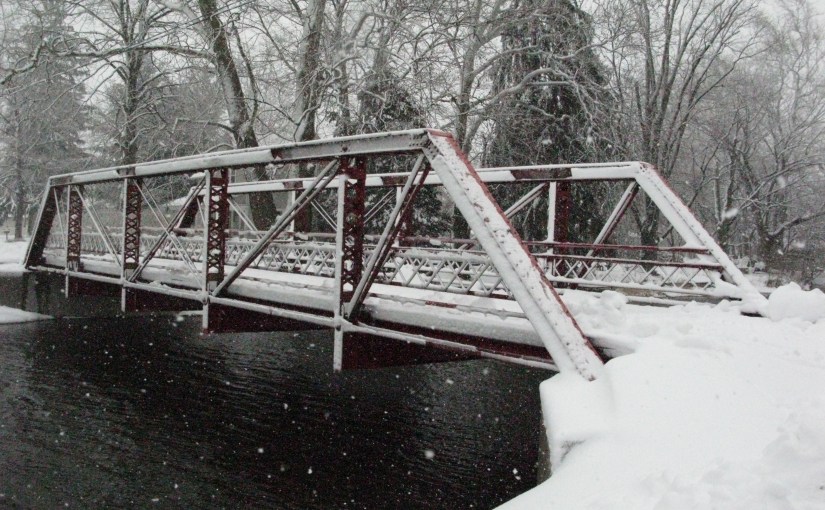
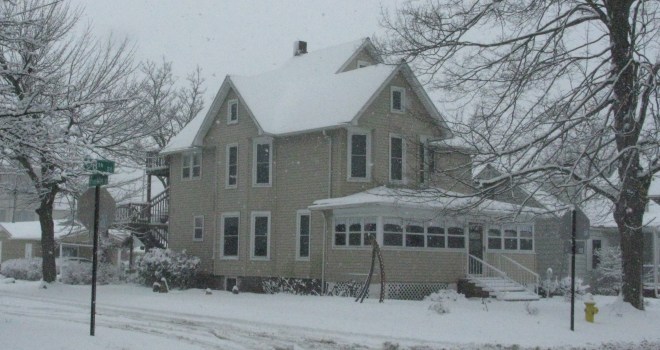
I came home from Thailand the day before and decided to walk, rather than drive, when I went to change my Thai baht back to US dollars and spend some time reflecting on our trip in “my” coffee shop. The best time to truly see your home is the day after a return from abroad. As I posted these photos I had a moment of deja vu. Of course I’ve been here before. It is my home of 23 years, I chose to abide here, hoping to become dude-like in my acceptance of the small pleasures of life. While it does not have the same pastels of the tropical sunrises I shot a week ago, I found  the snow made every shot in the camera look as though it were taken on the grainy b&w film of the 1950’s, and I relished the steel color of the river, the envelope-white sky, the dark bark of oaks and maples in the woods,  the faded red paint on the bridge and restaurant and the marquee, the browner-red bricks of churches and downtown storefronts… you’d think I’d rue the day I left the tropics, but I don’t. These colors aren’t boring to me, they’re subtle, they’re home. But that’s, like, my opinion, man.

In Thailand, a guy named Chase was giving me tips on photography, a sport at which I consider myself delightfully amateur. “Whenever possible,” he said, “zoom with your feet.” I zoomed with my feet for a closer look at my hometown and instead of hating the snow and cold (as I might have expected of myself) all I saw was beauty. This is how I know I’m beginning to learn to abide. The next morning, I went through the day’s images and found to my surprise that my luck-slop (a phrase Dad used to use when we played pool and I knocked a ball in on accident) shot of the day was a capturing of two geese in flight, perfectly in a space between the trees. I was holding the camera in my pocket to keep it dry when I saw them come honking their way up the millrace, then veer to the west. I drew the apparatus like a cowboy and fired three or four times rapidly, pow-pow-pow, missing badly each time, or so I thought. I didn’t even know I’d gotten them in the viewfinder at all when I was shooting, there was so much snow in my face. The trees all seem to reach out to them, lifting them up in their fidelity to each other, pushing them into the sky. My wife and I swam together, flew together, too, we kept honking at each other, and we have landed together.

As I walked I thought about zooming with my feet, and I thought about how a picture is worth a thousand words, and it occurred to me that if you are a poet your job is to zoom with your feet and then give people a picture in far fewer words than a thousand. That is very hard to do. I am glad I have a camera for the times when I can’t seem to quick-draw a poem, when I fail to capture the essence of a day in the viewfinder of my words. Even some days, when I am really abiding, I find it hard to describe the beauty of a heavy, wet snowfall. But it is basically the beauty of being at home.

IMG_3323 (2).JPG

More on “sonder”

Here’s part of an e-mail which arrived as I was heading off to Thailand from my good friend and alert reader Jason P.:
I just wanted to drop a note to say I really liked your chapter on “Sonder” in your book.  I’m apart of a small monthly group at Faith Mennonite and we reflected on another new term for me called “the loving eye gaze” which would basically describe as seeing God in nature and others.  I immediately related this term to Sonder which you introduced me to and told the group about your book and the term Sonder. 

A thought that I had was that practicing Sonder is done in living one’s usual “mundane” life, but you almost need extra ordinary events (like the trip your taking now) to give us out side perspective and to realize the importance of the “other” the “different.”  It takes a shake up of our routine to notice things outside what becomes regular to us.  A shake up to realize that others are just as complex and interesting as ourselves.   

As a response to your Sonder chapter I was wondering if you could give more examples of how Jesus showed sonder.  I don’t have the book in front of me now, but I remember you do refer to Jesus showing sonder in how he wanted us to live abundant lives and how he illustrated it by dying on the cross (being our “supernova” or some such verbage you used).  This all sounds well and good, but still seems a little abstract for me.  I was wondering if you could provide a few scriptural examples of Jesus showing Sonder, perhaps in a follow up blog?  Or perhaps your wanting me as the dear reader to do that in my own brain, which I think I can do.  I thoroughly enjoyed your Sonder chapter, but I was left at the end feeling like I wanted more examples from Jesus showing Sonder. 

Jason, thanks for the great questions. Sonder is a concept from an artist named John Koenig and I highly recommend checking out his other coined terms and the videos that go with them. If you see a good one mention it in the comments! In preparing my response I had to go back again and look at his original definition to see if sonder is something which can be “showed”. It’s defined as a particular awareness, and so I do think it can be, in the sense that your actions reveal what you are and are not aware of. For example, my children do not seem to be aware that leaving the door open in our entryway which doubles as a laundry room, during winter, jeopardizes our washing machine; lines freeze, washer breaks, repair bill ensues. Their careless action reveals their general lack of awareness. The awareness that people have lives which are equally intricate as our own is something that mature people who are not constantly focused on their own needs and desires exhibit often. As I thought about this today I was travelling; I noticed the hotel pool was lifeguarded by a man I’d bet is from India or Pakistan. Somewhere he has a family, whom he likely sends money, he sits around all day caring for this rooftop pool and what else? Who knows?

So, then, Jesus fits that mold too. How about the time when Jesus talks to the Samaritan woman at the well. “You’ve had five husbands,” he says. Not as an accusation, but demonstrating that he sees her life not as a passerby but in some sort of beyond-sonder intimate detail. I talked with my dad about that and he said, “yes, it must be a word of knowledge because it would drive you crazy to know everyone’s story in that much detail as you walk around.” I think that’s true. There are other times when someone might have gone unnoticed but for the fact that she dared to reach out and touch the hem of his robe. “Who  touched me?” The awareness is always there that people are walking around as shadows, perhaps appearing only once in his story, as perhaps he did in theirs. but the engagement wasn’t, at least so long as he walked in human form.
But he is always ready to default to the premise that they have great value. Greater than anyone sees on the surface. This lifeguard in Abu Dabhi may only make a few dollars a day, but the money he sends home may feed eight, or sixteen, mouths. He’s very valuable to someone, and that’s just economically speaking! The value Jesus saw in others, whether he knew how many husbands they’d had or not, goes far beyond their earning power. It’s the value of someone uniquely designed.

I’d love to hear other thoughts on how Jesus showed this awareness of others’ complex lives. I think there are lots of them, and lessons to be learned from each. One last comment: I agree that travel, and the arts, and other things, can really help us be more aware, notice others in new ways.  That’s an excellent point you made!

Thailand Poem #4

If you could take a whole rainbow

And stuff it back through

The prism from which it came, to the other side

I guess you’d manufacture light.

Good luck with that.


If you could take a free man

And shove him back

Through the prison from which he came, to the other side

I guess you’d manufacture innocence.

Good luck with that.

(PS: somehow when this first posted it didn’t have the last two lines. Huh, kinda lost it’s punch.)

Thailand Poem #3

There are many fish, but one ocean.

They may swim at different depths,

But they share one country.

There are many stars, but one sky.

They’re all so far away we may never reach them,

But they share one country.

There are many children whose father left long ago;

They may not know where they come from, but—

One day, like fish and stars,

They will gather in one country.

Then, they will

No longer know

What it means to be fatherless.


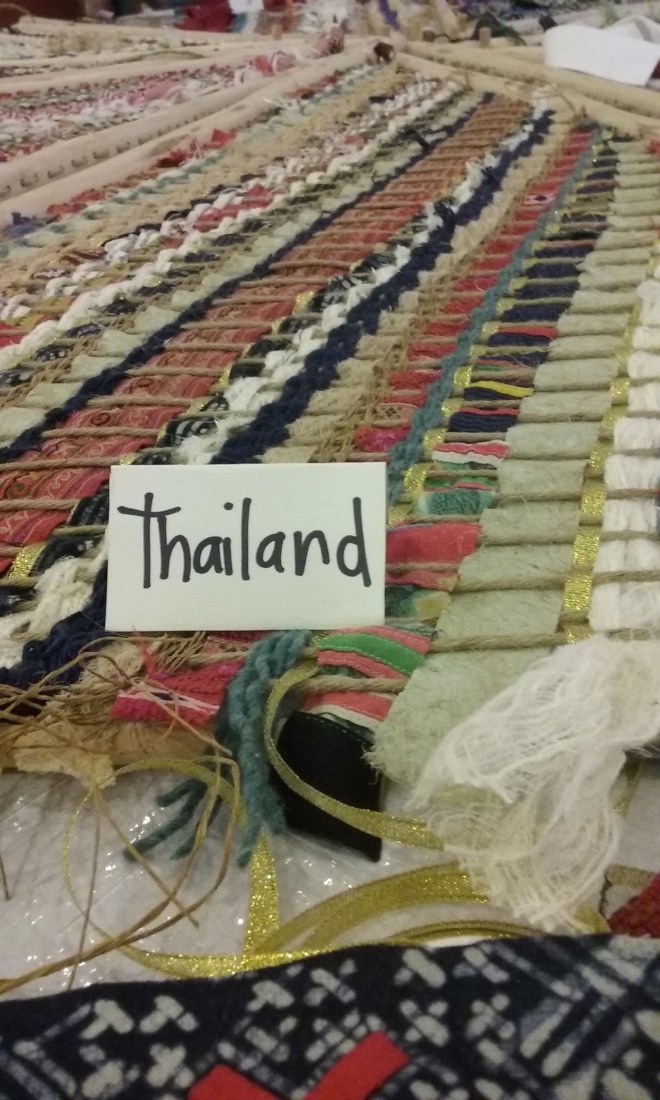
Dynamic Art, Thailand

What a privilege it was to watch South African artist Anneke Price, of Chiang Mai, Thailand, assemble this woven artwork this week! My only regret is that it had to be hung on a wall that was such an ugly color. Oh well. That was not something she could have controlled.