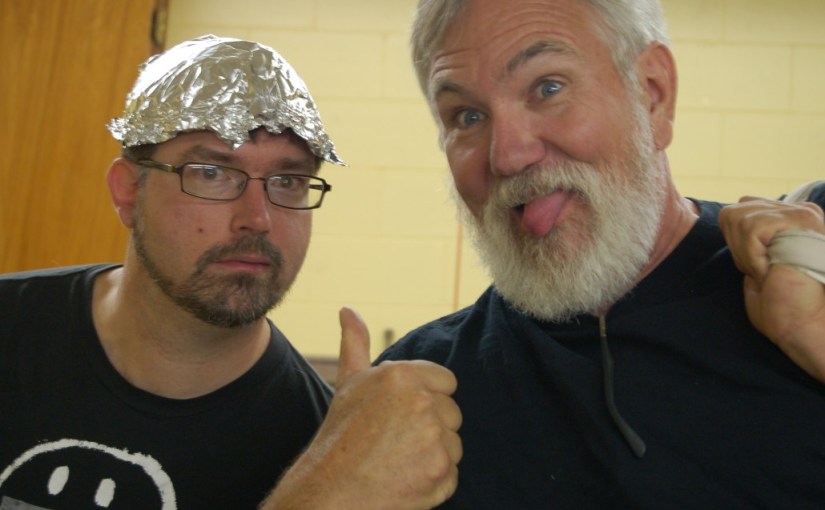
Pity The Fool

Fools have been around since before fire, before writing, before ceremonial burial, before baklava.

Fools were involved, even important, in the invention and discovery of all the ten thousand marvels.

Fools, I tell you, come in all sorts of packages.

They may arrive via the postal service in a plain brown wrapping,

They could be nestled in among their fellows like sardines, smokes,

There is a high probability you’ll find one the next time you surf

across the broad ocean of information, miles of content without surface tension, holding nothing up, just filling a gaping digital void, so that you can’t see the sea floor of your soul. A Foolish illusion.

There is a pretty good chance they will invite you to join them,

to sing for them at their next party. A gig! You wanted a gig, right?

It’s really sad how fools flock like sparrows, warming their feet

on the current that zips through the wires,

chatting you up, inviting you to electrocute yourself.

As though you were a bird-brain too, and could just flit away.

Despicable? Yes. We all know that.

Harmless? Yes. Perhaps. No. I mean yes. I mean, no; yes, harmful.

There appears to be some confusion about that.

Let me just say that I pity the fool who comes to me

and invites me to have my hands bound with black tape

to be thrown into a trunk

to be taken down to that river

to be slung in without ceremony.

“I will break your face, fool.”

What the fool doesn’t realize

(and this is what makes the fool a fool)

is that

I might even come along, but

Could the tape be silver instead of black?

Could the gag be made of phyllo, marzipan and honey,

so the river bottom would taste sweet?

No, it sounds fishy. Come on, fools.

Do I not at least deserve some ceremony?


Happy April 1st.


Soup in Spring

I ate three bowls of soup tonight

The best ham and beans and broth I have ever tasted

it reminds me of how I wooed my wife, one autumn,

With poems about the comfort of mom’s

Winnie- Ther- Pooh tomato soup recipe

and that in turn led me to ponder:

What is soup? It’s not food and it’s not drink

it’s Something in between I think

So in the spring and in the fall

I like soup the best of all

It’s in between the great extremes

It’s not just food, it’s made of dreams.


So I read it to her, and she says “hmm, kind of cliche. It’s an everyday poem.”

Then she kisses me.

Cliches can work, sometimes.


Love

Love is simple

Relationships are complex

Marriage is for life, even if you

divorce you will always have an ex

Family is as strong as its root system,

weak as the rottenest branch,

Wild as a pack of wolves,

or Cultivated as the roses of a manor,

depending on how they’ve established a culture.

But Children are always the future.

Children are always the future.

That’s because

Children remind us that

love is simple.


The Way

When you begin to follow the Way, you think that It will be tubular, like a wave to surf or like a water slide at an amusement park, the excitement mounts as you swim out, or as you climb the stairs, and you anticipate that with a whoosh, stomach dropping, you’ll arrive at the end of the run, just letting It do Its Thing. It should not be difficult, should It?

But the Way is not tubular, dude, it’s just a round hole in a plain plane, with eternal depth

(Whatever that means, “eternal”)

I am a square peg

Try as I may, it’s never quite a fit

I’m either too small, I slip and fumble about within the Way, grasping nothing,

Traction-less, spinning free and free-falling, not even believing I can fill the space enough to touch the circumference at my own four corners, or,

(more often) I’m too large, over-sure, arrogant,

unable to wedge myself into It at all.

The Way’s diameter never changes. I am the one who is inconsistent.

I am the one in need of endless calibration.

Hey, if you like my blogs, check out my bookstore in the sidebar. I have freebies for the next three people who buy one of my books through here, plus, autographed copy, ya know.


Madman

The madman walks past stiffly, quickly, down the broad avenue of packed dirt, (we are in the middle of the middle of Africa) and he is talking to himself,

invo-

invo-

invoking the Creator.

“Bonjour,” I say, being as friendly as I can. Twigs in his hair, eyes bloodshot, perhaps he slept in the forest, where he may have spent the insanely hot night

invo-

invo-

invoking the Creator.

His eyes see me for a moment, a flicker of recognition crosses his face (there’s one of the whites who is crazy enough to be in the middle of the middle of Africa). But

The fool does not reply, he simply goes on his way

invo-

invo-

invoking the Creator.


Questioning Authority

Here’s a question my brother Aaron asked via social media today.

“I’d suggest that rather than questioning authority we might do better to think about authority. Where does it come from? What is it for? Do you know anyone who wields it productively? What are the limits of obedience to authority? Why? What is the difference between authority and power? But don’t take my word for it…ask a question of your own!”

Aaron, great job starting a discussion on a very interesting topic.

I called him and we talked about it together particularly in light of my March 15 blog titled Family Values in which, as I told Aaron, “I excommunicated roughly half of the North American church.”

“Really? You did?” He said. “Under what authority?”

“Are you questioning my authority?” I said.

“No, I’m just asking a question,” he said. Ha ha, we laughed.

I explained the core concept of the blog to Aaron in a little more depth and then posed the question back to him, “where do you think I got the authority?” To which he replied, “your authority came from a revelation from God.”

Well, that means it is prophecy. As I begin now to exercise a prophetic voice more often, I was asking myself these questions, too.

I’d like to start out the discussion by saying I’m not an expert on authority, but my basic observation is that authority, in general (I’m not talking about spiritual authority) comes in one of two basic ways: via a vetting process or via a personality cult. In the above conversation with Aaron, there’s a particular vetting happening when someone else verifies “your revelation came from God.” Vetting is a HUGE part of the process of becoming an authority on something.

Aaron said, “Well, all those vying for president right now haven’t been vetted,” and I said, “No, they don’t have any authority yet. Authority goes in stages, from one stage to the next you’re vetted. For example, Kasich has the authority of the Governor of Ohio, so hes asking us as a nation to vet him to the next level.”

For another example, my authority in the field of life coaching was vetted from a third-party perspective at CCNI and they decided that the quality of my work deserves the credential (authority) at the CPCC level. This was a more stringent vetting process than simply earning a certificate from a training school. It took me seven years to get from the certificate to the credential. The next credential (Master Coach) might take another 10 years.

The flip side of vetting is the WRONG way to get authority. These guys are the political demagogues and personality-driven church leaders. Typically (if they attain any amount of authority that puts them in the public eye) they have a certain and very rare personal charisma. They can stay small and out of the public eye, leading a group of just a few hundred people, and yet even then when their downfall comes about often times the leader of even a group of only a dozen will end up in the public eye as their abuses come to light. When the authority comes from personal charisma, nobody’s holding you accountable to integrity.

Think about how Donald Trump got where he is today, asking the country to vet him in the election process. What political authority has he had before? None. His vetting process up to this point has been based on a personality cult he’s carefully constructed with a great deal of personal charisma and it has no particular basis in terms of integrity; based on all that, he’s very close now to getting a nomination (which still isn’t the authority of the Presidency). Kasich is pretty disgusted with this whole thing; he’s the governor of Ohio, he’s the candidate on the GOP side who’s held the most authority in a position similar to President. Why isn’t he the obvious next candidate for authority on the GOP side? An entertainment-driven society has deceived people into thinking that personal charisma is a reasonable way to become authoritative.

You see the same thing with Bernie Sanders on the Democratic side. Like his message or not, it’s been the same for 30 years and that means he’s speaking with integrity. When Hillary Clinton says “Where was he in 1993?” His campaign retorts “He was literally right behind you.” Clinton doesn’t look good when she tries attacking Sanders on issues of integrity. Let’s leave politics behind. I’m not an authority on politics. Ha ha.

What is the key characteristic that typically motivates those in authority over others to vet them up to the same level? I submit that it’s integrity. Promises fulfilled. When you’re given a certain level of authority and you fulfill your commitments and live a life of quiet integrity, people see there’s authority in that and they elevate you to the next level.

In a sense, it’s not terribly different from power, in the sense that Margaret Thatcher famously said, “Being powerful is like being a lady. If you have to tell someone that you are, you probably aren’t.” But there are differences, too.

So, where your authority comes from is not how you lead into a discussion. You state what you have to say. Jesus did this. “He spoke as one with authority.” Then, if people ask “where did you get your authority” (and they will) you can tell them. I don’t start a coaching pitch by saying, “I’ve got a CPCC with CCNI” partly because people are going to say “so what” (not because CCNI isn’t an authoritative body, but because they may not have ever heard of it). That won’t work partly because that’s a weak opening statement compared with, say, for example, asking a great coaching question that shows I’m a lady … um, wait, I mean, shows I know what I’m doing as a coach. A powerful use of authority assumes you have it.

The thing about questioning authority, then, is really asking “Does this authority have the integrity needed to maintain their authority?” and sometimes the answer is NO!

Should we question authority? Sure, we should. Aaron did it to me. He said he wasn’t, but really in his question “what authority do you have to excommunicate half the church?” is implied that we need to know where the authority comes from, we want to know if you have the integrity to carry that authority, and we want to keep checking in on that from time to time.

A really good leader doesn’t need to be questioned too often. Follow 90% and question 10% seems to be a rule of thumb that comes to my head. The whole political discussion isn’t to pick sides here, it’s really to illustrate what needs to happen in our churches (that’s the realm I have a lot more authority to speak to) which is this: once we’ve decided to put someone in a position of authority, we need to follow them. We get to expect that they are accountable, and we do not have to be their accountability partner, coach or mentor or overseer. In fact, it is best if we are not functioning in that role if they are also our pastor.

Does that mean we should never question their decisions? Or their integrity? Or their authority? Of course not. But why would we put someone in a position of authority if we didn’t vet them for a measure of integrity in the first place?




Foundational Coaching Skills Training

Interested in getting trained in Foundational Coaching Skills? I work together with CMI to provide this training every year. I don’t own the training, I just help lead it, but I can confidently say that as someone inside the industry this class is the absolute best value you can get anywhere. That’s because the training is top notch, and if you apply yourself for the entire course you’ll have a great grasp of coaching, and you’ll get it at a fraction of the price you’d get anywhere else. The deadline for this year’s FOCOS Indiana course is looming, so read more about it today if you think you might want in!

Want more info? Here you go.

Family Values

Our family looks a lot like what they call “traditional”, mom and dad and four kids, we gather around the dinner table I’d say four nights a week on average and sit down and eat a meal together just like good old Ronald Reagan said we ought to, if we want to make America great. That was the example my parents set, it brings us all together when we eat as a family.

We sit down and we ask each child what their successes and their sayings are from the day at school. They’re still learning to accept the fact that each day brings with it at least some sort of small success, and a good saying can be that. A little piece of humor or poetry, you know? Something you said that was smart, or witty, or worth repeating in any way.

If my wife and I have any values at all, the first one is that each child is loved, and as they grow up it’s not going to matter what choices they make in life, they’re still going to be welcome at our table. But there are certain things expected of you when you sit to eat here. You’re expected to be grateful to the Creator for something, and you’re expected to give respect to the cook, and you’re expected to make sure that everyone else has enough. If you come to the table or even walk into the kitchen with some lesser attitude on any of those three items, you’re going to be asked to check your attitude at the door. And I mean literally. The other day, one of my sons came home from school to rummage through the fridge, then whined at my wife about how someone had eaten the last cinnamon roll, or some such nonsense, and I told him to go back outside, check his attitude at the door, come back in, and speak to his mother with respect. We aren’t strict, authoritarian parents. There are only a few behaviors that get you dismissed, but they are serious, because they destroy the culture we’re building, and bring everyone down. But when it comes to breaking bread at our table, you’re always going to be welcome, so long as you come with respect, thankfulness, and generosity towards others. It’s never going to be about their lifestyle, it’s about their attitude. A bad attitude at the table is like a virus, and I don’t want you sneezing on my plate. There’s a word for saying no to people who come to break bread and think they can bring the hate, too, and that word is “Excommunicate.” Definition: To remove from the table of communion. You don’t get to eat with us, clown, because you’re dragging us down.

And that’s why I’m calling for the immediate and unequivocal excommunication of the hate nation. I don’t care if you call yourself a Christian and read the Bible every day, hater, you’re not part of the church is what I want to very clearly say. You don’t get to sit down and eat with us when you bring that attitude through the door. I’m not really talking to anyone who doesn’t consider themselves a Christian, but the so-called evangelical voter block is making it clear that they’re ready to let anyone near know that what they hold dear is founded on this fear that makes their world a tight little comfortable bubble of hatred, and I personally excommunicate you, I ask you to go back outside, check your attitude at the door and knock.

Just go outside, change your attitude, and knock again. Jesus said if you knock the door will be opened, so there’s not really that much required. Respect, thankfulness, generosity.

When Jesus says “learn what this means: I desire mercy, not sacrifice” that means that no matter what your grandpa did in World War One or Two or Five, to sacrifice for this nation, means very little if you think it gives you the right to keep it all to yourself like a child who takes the last three cookies.

And let’s make sure to understand this isn’t about a certain candidate and his particular plan, because I realize that once he loses, which looks inevitable, we’re not over the hump. We still have a problem, and there are plenty of people who are attending a Christian church on Sundays who are fueling that fire, and it’s time for the rest of us to stand up and say NO. You don’t have a place at this table right now. Haters, I excommunicate you. I won’t eat what you eat. I won’t march to the drum that you beat.

Excommunication, man, it’s not for life. You can ask my wife – my kids know how to correct their attitude. They understand when they’ve been rude, and they eventually come around because you know what, when they sit down and eat with us they don’t just get food. They get loved. They get to be part of a family that’s more than just the kids, the wife and me. And when they get sent out, we all hope they’ll come back soon. It’s not the Wild West at high noon, I’m not saying there’s not enough room in this town for the both of us; in fact, I think there’s room for quite a few more at this dinner, but if you spoil it for everyone, we’re going to ask you to leave; it’s sad, because we all end up thinner.

Just go outside and check your attitude and knock, and we’ll be glad to invite you back in. But until then, you’re not welcome.

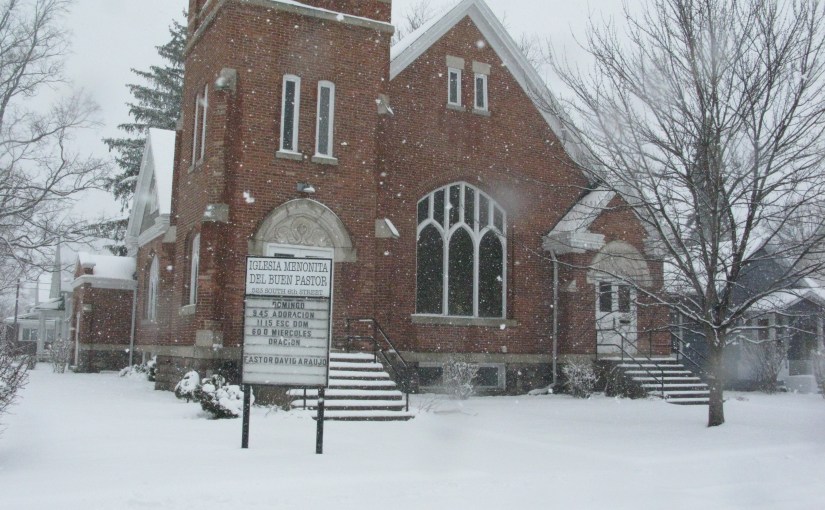
Update: I’ve spoken with Pastor David Araujo of Iglesia Del Buen Pastor this morning (3/30/16). He was kind enough to bring to my attention a concern in our community about this blog and the church building pictured with it. Some community members felt that perhaps this blog was an attack on that congregation. Pastor David has been a guest in my home when some good friends of ours were here to talk with a group of us about Christian-Muslim relations. I know pastor David and his passion for peacemaking among many cultures. I realized immediately what the misunderstanding must have been. David encouraged me to leave the picture of Iglesia del Buen Pastor up on the blog, because as I explained to him, I simply felt it was a beautiful photo of a beautiful building.  We have a mutual desire for diversity, not for a society based on hate and fear. I hope that it is clear that I do not want more walls. I want fewer ones. But the walls that keep the snow out while the congregation of Iglesia del Buen Pastor are worshiping are good and beautiful and welcome walls to me. Just to be clear, my intent is not to excommunicate the people of this fine congregation! I celebrate even more their presence here because Pastor Araujo was willing to come and bring this concern to me! What a great example of peacemaking in action. Thank you, Pastor. The last thing I would want is for a misunderstanding of this magnitude to go unaddressed. These brothers and sisters are exactly the kinds of people about whom we should be saying “do they have enough?” Pastor David is welcome at my table any day of the week!

Time is jealous of her audience

When the day begins, the sun comes up halfheartedly and pushes against the darkness,

casual like your knee showing through torn jeans,

or a curtain tugged reluctantly aside in a dingy theater.

Time enters, steps to the center, comfortable with her own pace,

and now she stage-whispers an aside:

“When will you see that I’m the main player? I’m the good girl next door,

Not like that dirty whore, Money.

What a slut she is, shoving me into the corner,

begging you to dote on her–

She even claims to be me, or that I am she!

Don’t you know– ? You could spend all day with me.

But with that impostor, the minute you begin to spend, she is gone.

I’ll still be here when night falls

And the moon shines down on us, abed together.

Yes, I’ll still be here when you stop groping for Money.”

Time is jealous of her audience with you.


Dear reader, if you’re enjoying my poetry, now’s the time (ha, ha) to order one or both of my books. Thanks, I appreciate your support!

–Adam G. Fleming