
Fusions in the Void, Number 10. Hot and Cold: The Eye of a Storm

Tornadoes suck. (Why not start with a bad pun?)

Cyclones, eddies, hurricanes, tempests, tornadoes, twisters, typhoons, vortices, and whirlwinds: In the middle there’s a void. A vacuum.

When they begin in the air, it’s with a clash of hot and cold systems. The cold shoves itself under the hot; the hot leapfrogs over the cold. Their push-of-war creates a rush, a cycle, a spin like a washing machine, spinning to the point that centrivical force takes over. High winds. Destruction in its wake.

And yet, in the center that void. That calm in the eye. In this case the void is a place where calm reigns in the midst of hot and cold. Hot and cold fuse not in the void but around it. It is said that one of the most frightening moments in a hurricane is the eye. Everything gets calm– too calm. Eerily calm.

What’s good in this? Where is the hope I’ve talked about so many times? First of all, in the eye, you’re midway through. If you’ve identified yourself in a Void Season (dark night of the soul or valley experience) then you’re already half done.

Jesus said that we should either be hot or cold, that if we’re lukewarm he’d spit us out. It’s true whether we’re talking about a cold  drink of water or hot tea, either way we sort of want our beverages to refresh us by either cooling us off or warming us up. The void arises when hot and cold attempt to mix. You can’t slam them together and have lukewarm air without a fight, without something getting knocked about. Eventually the environment in a single place is going to get a shift. You will have a change as the storm moves through. If it was humid and hot, now it will be drier and cooler, or vice versa. Things won’t stay the same. Whatever life was like, when the storm passes, it will be different. There’s no avoiding it. In the Void experiences in life, we have this moment were everything is still. We don’t face choices — not yet. We will come out the other side of the storm with decisions to make, and those decisions will be made well if we embrace who we’re becoming while we’re in the middle. Or, at least, embrace that we’re becoming something new.

If you don’t embrace the idea that you’re changing after the store is over, that a shift is coming, you’re liable to pick up your folding chair and try to take it along with you wherever the eye of the storm moves. In other words, you stay in the place of limbo longer, rather than accepting the idea that you’ve got to get through another half of this storm before you can proceed. Once the storm passes, you’ll take stock of your surroundings. Perhaps some things will be left untouched. Other things will be knocked down, some of them unrecognizable. It’s a chance to start fresh. I’m not saying it’s not scary. I know it’s terrifying! But the only way to find out what the landscape looks like and how that’s going to change your life is to move through the second half.

The Void can last a long time. Sometimes people prolong it by trying to stay in the middle of the Eye. Counter-intuitive as it may sound, it’s really quite comfortable in spite of its emptiness and eeriness. At least, in the Eye, we don’t have to face the future too much.

What’s God doing in the Void, in the Eye? He’s fusing hot and cold. Because eventually they will mix together. Not so that you can be lukewarm, but the storm doesn’t last. Storms play out. The hot and cold mixed, things settle down. God’s fusing things we can’t see while we sit in the middle of a crazy wind and listen.

In fact, God is in the Void with us, as Elijah discovered:

“Go forth and stand on the mountain before the LORD.” And behold, the LORD was passing by! And a great and strong wind was rending the mountains and breaking in pieces the rocks before the LORD; but the LORD was not in the wind. And after the wind an earthquake, but the LORD was not in the earthquake. 12After the earthquake a fire, but the LORD was not in the fire; and after the fire a sound of a gentle blowing. 13When Elijah heard it, he wrapped his face in his mantle and went out and stood in the entrance of the cave. And behold, a voice came to him and said, “What are you doing here, Elijah?” (1 Kings 19:12)

Elijah then catalogs his feats. And God ignores them. All the instructions Elijah gets from God at this point involve sweeping reform. He’s instructed to crown two new kings and his successor is selected. What was God doing in the middle of all that storm? He was shuffling the deck. And He didn’t particularly care what Elijah’s track record was. It was time for something new.

We expect that in the Void God is out there throwing earthquakes around, when really he’s sitting right inside it watching to see whom we’re becoming. And He’s shuffling the deck. Be ready to have your track record ignored. It’s not because we serve an unloving God, it’s just that change is inevitable after the Void. Embrace that. A new day is coming.

Writer’s Group: Setting a really great goal

What sort of goal pushes you but is attainable? That’s what Justin and I have decided to push ourselves and our group toward, so that each one is making headway in writing their book.

I’m setting this blog up a few days in advance. I committed to 15,000 words this month and I have just over a thousand left, two days to go. I’ll attain my goal. I’ll push for that last amount partly because I’m leading and it would be poor leadership if I don’t lead by example, and partly because I’m serious about meeting my goals anyway. And partly because I’m committing to it once again, with 51 hours to go.

We fully expect that the writers in our group will publish their books sooner, more frequently, and with more quality than if they were not in the group.

Yesterday I sent my editor my final comments on the first round of corrections for the full draft. In less than two weeks, my goal is to finalize all the copy and send it to press. I’m ambitiously shooting for publication, for books in my hands, by December 1.

Set your goals just low enough that you can attain them every month, and just high enough that it will take effort. Both of these are important. You MUST attain your goal each month, otherwise you become discouraged. You must also set it high enough that you have to work for it. Otherwise it’s not a goal. Think of it this way: if you say “my goal is to eat three square meals a day” but you already do that anyway, as sort of a natural course of events, it’s not really a “Goal,” is it? But if you change the goal to something like this: “I will eat small portions including hard boiled eggs and carrot sticks six times a day, making sure to chew my food completely, and cut out sweets for the next eight weeks” there is a pretty good chance you can do it, and a pretty good chance it will take some conscious effort. Just like health and fitness goals, writing goals must be attainable to keep up your enthusiasm and courage, and hard enough to let you know there’s effort involved. Best of luck in November, when many people write short novels … but you could be writing novels every month with just a little more regular discipline and accountability!

Writer’s Group: Wrapping October (already!)

Next Thursday night, on the 22nd, it’s time again for Writer’s Group.

Two things to do in the next week if you’re participating. First, watch the video on relevancy and inspiration, you can find it on the Writer’s Group page here.

2. Start thinking about what sort of goal you want to set for November. November is that month when lots of people write a whole novel. Personally, I’m thinking about doubling my target from September/October and going for 30,000 words in four weeks from Oct 22 to Nov 19. By the end of October, we should be just about done editing my nonfiction project, and a 30,000 word goal in November would put me close to 2/3 done with my next fiction trilogy rough draft: I’d be over 120,000 words!

Maybe this November is your time to finish off the draft for your first book. But I think any month can be your NaNoWriMo. It depends on your schedule and determination. Is this your month to double your goal? Maybe it’s not. Be realistic! Nothing builds your energy for writing like hitting your realistic targets month after month.

This group is effective. Our participants hit their goals. If you want to start attending the writer’s group that meets monthly, send me an email to find out what the requirements for participation are. If you want to let others know how you’re doing this month, please comment!

UPDATE: I’ve written 13313 words this month. Under 1700 to go to meet my goal next week. How are you doing?

Writer’s Group: Even when editing

Justin and I were talking about what to do with those in the group who are moving into heavy editing phase. If you’re editing, I said, you still need to keep momentum going, perhaps even for your next project. So we’re encouraging people even when in the midst of editing heavily that they still need to hit a minimum word count. That may be a blog, or working on the next story, or a poem. If we get too mired in editing, it becomes easy to quit writing entirely when the book is done. I’m editing a lot this month, but still shooting for at least 15,000 words. How are you doing?

Next group will meet Oct 22 at 8 PM eastern. If you want in, contact me. Drop progress reports in the comments! Keep up the good work!

UPDATE: Since I’m leading the group it’s important that I practice what I’m talking about here. I have been in heavy editing phase the last three days, but I’m still on track to hit my target of 15,000 words this month — and that’s not including what I did to my manuscript in second draft over the last few days. Vital stats for me today:

Goal is 15,000 words. 10,821 so far, 4179 to go with 13 days remaining. 321 words a day. Easy as pie to hit or beat that target.

Writer’s Group: You get an extra week — what will you make of it?

Hey everyone. So this month we have five weeks between meetings.

We all bumped up our goals for the month, but seriously, I bet we can all beat them by a significant margin. There are still three weeks left, but don’t be like that 1600 meter runner who lags badly on lap 3 out of 4. The “third lap” on the track for the runner who is attacking the mile (metric version) is where the gap is made up. It’s easy to run a good time the first lap when fresh, and easy on the last lap when almost done. It’s what you do with the middle laps that makes all the difference. Roger Bannister got this, and the mental edge gave him the first sub-4 minute mile. Granted, he was gassed:

bannister

SO we get three middle laps this month instead of two. Stick to your pacing!

Our next group meets Oct 22 at 8 PM eastern. Drop comments on how you’re progressing!

Congo: recent trip brings me full circle

I didn’t set out on this journey to become a life coach with a specific direction of coaching missionaries or impoverished pastors in Africa, or training coaches for cross-cultural work. It would have been around this time of year, in 2007, that I took my first short training course in coaching. Eight years ago (I was 33 years old) I don’t know that I had any solid concept of target market. Maybe I still don’t. Along the way I’ve coached entrepreneurs in the arts in the USA. I consider myself one of those (as a novelist). I’ve coached some business people who were working on figuring out or honing their life purpose. I’ve worked with people from quite a few different walks of life in the USA and now I’ve worked with clients or trainees in well over a dozen other nations, too; I’ve worked with people on every continent except Australia. I’ve even coached some penguins. (That’s not true, but if you know any professional hockey players in Pittsburgh who need a life coach have them give me a call.)

That’s not to brag about my cross-cultural exploits; in fact, the point is that it wasn’t really where I saw this whole thing heading at all. I hoped that I would coach some business people in North America at rates that would provide a lifestyle of beyond-adequate means, and that it might mean I could also afford time and energy for pro bono work; I hoped for a nice mix. That hasn’t happened, and at this point I don’t particularly anticipate that it will. It appears that I have come full circle so that the most formative part of my youth leads into the most impacting part of my life as an adult. Which makes complete, logical sense.

Showing up at MPH Guesthouse in September of 2015 was really not so much different than showing up there in June of 1987. I mean that in the physical details of the place much was the same. The open, central dining room with balcony looking over it from all four sides, from the second floor where most of the guest rooms are, the walled-in garden sprawling out behind the building with fruit trees (the mango trees probably a bit bigger than they were) and a tennis/basketball court (much more dilapidated). Everything still in the same place, comfortable in the way a church campground often is in the States. A world unto itself, a place for rest and retreat. A bubble. A place to put outgoing mail for friends in the USA, where strangers might take it by plane and deliver it to a mailbox leading to a functional postal system.

But more telling is the condition of my heart. When I arrived in Kinshasa, Zaire in 87, everything smelled foreign. Back then, it was still quite common for US Americans to embark upon missions as a lifestyle with intent to give decades of service to learning a local language and enmeshing their lives within the context of a village somewhere. We called it living a life of service, we called it living for the sake of the Gospel, we called it becoming a career missionary. But that whole idea was foreign to me, as was Zaire itself, because by the age of 13 one does not think one’s parents are career missionaries. One thinks one’s parents are exactly whatever they have been in the past; with any stability at all from one’s parental experience, one expects the stability to stay just as it is: stable. I wanted stability, not foreignness; but lapped up the experiences like a drunken boxer: slightly off kilter, just ready enough for the punches that they’d only spin me around again, rather than knock me down. A dizzying time, heady. Perhaps one might say I’ve never been completely stable since that moment we got off the plane in Kinshasa, 1987. The bubble that was MPH Guesthouse was our first stopping point, and while still a bubble, it was a bubble floating upon a foreign liquid, and when it popped, it was the last vestige of life I’d known.

As adults we learn that life is not at all static. We see places go through transformation, we see people, as well, who’ve transformed. I have a friend who kicked his alcohol habit and became a pastor. I know people who have gone through nasty divorces; some are the better for it, others still reel with the pain and devastation. Nations change too. In the USA we had the formative moment for our generation 14 years ago this month, on September 11, 2001; so formative, even, that in many ways we think of events during the span of our lives as either before or after 9/11. In Kinshasa they had their moments too — on several occasions Congo’s unpaid soldiers went on looting sprees, the first one was on 9/23/91, 24 years ago this week. Kinois, (as the residents of Kinshasa are known) still remember those days; they lived through several lootings and none of them are remembered fondly. Luckily or by the grace of God, MPH Guesthouse was not looted and remains a place of stability in the midst of relative chaos. By the grace of God, I, too, was not devastated by people or events and still stand to take on what comes next.

Now it seems that our most formative experience in our youth is often the most valuable in our calling, as we discover many years later. To be able to stand in that place where cultures collide and create, even if for an hour, some sort of bubble where people can find refreshment, is to consider my life as a cross-cultural coach is to think of myself in some ways as a living embodiment of the MPH Guesthouse itself: I create space where people who work cross-culturally can come for a moment of reflection, retreat and can prepare to go back out and take on what comes next for them. The reality is that we still have people going to live cross-culturally. Maybe we’re not sending people in the same way we did in the 1980’s, but it still happens. I have close friends about to leave for Central America. Long term. They are rarer birds, perhaps, in a jungle increasingly cut down as the world gets smaller and as people increasingly find reasons to stay where they are, but … these rare birds will need a sanctuary.

And then, too, more people are going into cross-cultural missions from homes outside the USA. The church I visited 8 days ago in Kinshasa was preparing to send a missionary to a country in northern Africa. We haven’t stopped working cross-culturally. In fact, with the advent of the Internet, we’re more able now than ever to work in cross-cultural contexts. The bigger danger is the temptation to retreat to the Internet when we wish we were at home (something I could not have dreamed of in 1987). But the Internet is not a Guesthouse; at least, not unless it is the vehicle taking you to an intentional conversation with somebody who works within your support community.

As for me, I’m making my peace with the idea that I’m a cross-cultural coach, that my calling is to work in primarily pro bono settings and that this is effectively exactly what I was designed to do, from the moment I set foot in MPH Guesthouse in 1987 until now. Coming full circle includes a recognition that the need is there, that indeed I’m already busy with it, and that it is worthy of support in its own right.

Writer’s Group: We are writing books

Just a quick encouragement for the people in our writer’s group (see writer’s group page in sidebar).

Yes. We are writing books. Last week we got an update from Justin, whose goal was 8000 words this month. He wrote 8100 in spite of duress. Tim also chimed in on his goal of 4000. He wrote about 5000. And on my goal of 10,000 I had written 14,400. 6100 of those were on my novel, which really feels like a side project while I finish The Art of Motivational Listening, but when that book is done, it’s going to feel really good to have the next novel moving along even if it’s at a fairly slow pace.

Because we are committing to write words every month, we are, therefore, indeed writing books.

If you’re in the writer’s group (next meeting is Oct 22 at 8 PM Eastern) please hit us with a comment on how the week went!

Congo: The Ancient Villagers

The joke in Congo is always “Chef du Village” which sort of refers to the village chief of course, but might be used in context of who is first in line to wash their hands before the meal or some other insignificant thing where you’re sort of the boss.

One of our trainees told a story about a time when a villager asked him a deep probing theological question he couldn’t answer (he is a theological bigwig.) When he used the word “villager” he apologized, and in the USA he might have been apologizing for calling the guy a “redneck” or perhaps a “bumpkin” or “hillbilly”. So his point was not to denigrate the villager but actually to commend his insightful question, but he didn’t have another word to describe the person’s living condition but to say “villager”.

That’s the backdrop upon which we found some pretty important contextualization for coaching in Congo: I described and demonstrated the technique where, listening carefully, I repeat back to my coachee word-for-word what he said. Not adding any analysis or interpretation of what they said, simply repeating it back: “If I understood you correctly, you said _______”.

When I was done demonstrating this technique, Jacques pointed out that the Ancient Ones (Elders) in the villages had this skill down pat. In fact, it’s an aspect of oral culture that they’ve lost. It was easy for the Congolese guys to see the value in this aspect of coaching, because it’s something that, at least in the past, had value in their culture. There are aspects of wisdom that village elders have had all over the world that have been lost, or nearly so. Interesting that modern leadership techniques might revive the value for them. Something to chew on as you become a better listener today. Perhaps you’ll even become such a good listener that they’ll call you “chef du village” without any irony!

Eephus ain’t nothing

A Philosophy of Listening

Carpe diem

One day I think in 2010 while I was volunteering at a local soup kitchen, I walked past a bookshelf full of romance novels. Serendipity means finding a book worth reading on a shelf full of romances. Nassim Nicholas Taleb’s The Black Swan: The Impact of the Highly Improbable was sitting there. I’d never heard of it before, but even the way the spine is designed said “this is not a romance novel.” So I seized the day, plucked it from the shelf, took it home, and began to read philosophy again.

In fact, I had read Why Art Cannot Be Taught by Elkins a few years before but perhaps didn’t see it as the philosophical book that it is. But the point is, since graduating college I hadn’t really engaged my brain that way. Once I read The Black Swan I had to admit to myself I was reading stuff that was a bit over my head, and from there I read Zen and the Art of Motorcycle Maintenance and so on. I began again to engage philosophy, this time in a much more serious way than I had during my undergrad years. You don’t have to have a graduate program to make yourself read.

My basic conclusion after reading Why Art Cannot Be Taught was that Elkins was correct in saying that Art cannot be taught, but incorrect in failing to offer a more excellent way to engage with art students. Coaching, I believed, and a community of authentic relationship, may not teach anyone to become a “great” artist as defined by fame or wealth. But it could help artists to become better people, more well-adjusted, less prone to isolation and even to suicide or self-medication – things which have been known to destroy artists in their prime. If you want to become an artful motivational listener, that is, if you want to listen to people and watch them walk away and succeed at attaining goals and dreams, this is a science to some extent which can be studied like the science of mixing color. Just because you can mix red and yellow to get orange doesn’t mean you can move people. Just because you can ask powerful questions, like “What do you hope to get out of this session” doesn’t mean you’re going to become the most famous or wealthy coach. But then, this isn’t necessarily the end of an art-form like listening. As Ronald Reagan said (or repeated) “There’s no limit to what you can accomplish if you don’t care who gets the credit.”

Perhaps the first thing we have to lay down to learn this art is the idea that it will somehow become a great career and that it might make us famous. (Incidentally the same goes for writing. You have to come to the place where you don’t care how much money it makes or how famous you will become – you simply have an idea or story to tell. Then you become productive.)

One of the biggest philosophical questions of all time is this: What is Truth?

As a motivational listener, you’ll be listening for that too. But not so much in the way of a judge or lawyer in a courtroom. Instead, you’re listening for the truth like a hunting guide looks for bear or cougar spoor. Yep, the old biologist’s joke is true: bear spoor happens. The real value of being a hunting guide is in recognizing the unexpected for what it is. If you were teaching people to hunt for deer in northern Indiana, where I live, you’d think it’s not so difficult to avoid the danger of becoming prey. But there have been stories in the area of bears visiting from Michigan’s Upper Peninsula. Some years ago, perhaps around 2007, I was working in Ohio and saw a newspaper article discussing the fact that several people had spotted a cougar in their backyards. A representative of the Ohio Department of Natural Resources was quoted as saying “there are no cougars in Ohio.” Now there are many current articles about cougars in Ohio woodlands. As unusual and unexpected as they may be, you would do well to recognize the signs of this animal in your vicinity – and to be able to say to yourself the first time it happens, “I know there are no cougars, but here is a cougar,” and to take appropriate action. Being able to recognize something which is highly improbable is a key component, possibility as a critical piece of truth, that takes awareness and alertness that’s worth paying for.

On the flip side there are things we may uncover as we track that could help, as we listen to people’s story, which could lead to discovery of something spectacular, perhaps even resulting in some sort of breakthrough, and dare we say, greatness. To continue with the hunting guide analogy, knowing how to find not just any buck, but the twenty-point buck; to not just locate the hole where any northern pike are hiding, but to catch a record fish.

So, the art of motivational listening, like any other art, perhaps cannot be taught. But there is one thing I can tell you: you are looking for something you do not know. This is the core idea behind Taleb’s Black Swan. The Black Swan event is “an outlier, as it lies outside the real of regular expectations, because nothing in the past can convincingly point to its possibility. Secondly, it carries an extreme impact… Third, in spite of its outlier statues, human nature makes us concoct explanations for its occurance after the fact, making it explainable and predictable. … It Is easy to see that life is the cumulative effect of a handful of significant shocks… Black Swan Logic makes what you don’t know far more relevant than what you do know. Consider that many Black Swans can be caused and exacerbated by their being unexpected.

This is what we’re looking for when we listen. Where are the handful of shocks, positive or negative? To refer to an earlier essay where I discussed the nature of the knuckleball, say for example that you are the batter, and the knuckleball pitcher makes a mistake. He throws a pitch that rotates, and the ball, rather than knuckling impossibly, suddenly becomes very hittable. The only problem is that you may be so surprised by the relative ease that you miss the pitch anyway.

Another pitch, even more rare than the poorly-thrown knuckleball, relies on the surprise. This pitch, called an eephus pitch, is served up to the batter in such a way that it is intended to be so hittable that the batter misses.

Wikipedia notes: “The delivery from the pitcher has very low velocity and usually catches the hitter off-guard. Its invention is attributed to Rip Sewell of the Pittsburgh Pirates in the 1940s. According to manager Frankie Frisch, the pitch was named by outfielder Maurice Van Robays. When asked what it meant, Van Robays replied, “‘Eephus ain’t nothing, and that’s a nothing pitch.” Although the origin is not known for certain, Eephus may come from the Hebrew word אפס (pronounced “EFF-ess”), meaning “nothing“.[2]” 

The Eephus pitch must be used with terrible infrequency – a complete outlier. The minute it becomes expected, it becomes worthless. It’s no longer a Black Swan Event. Sometimes it’s called a ball, sometimes a strike, usually makes the batter laugh, fools even the umpire, and once, Ted Williams hit a home run in the All-Star Game on an eephus pitch. Ted Williams was the kind of batter who was always ready. Ted was one of the greats.

Greatness, in terms of “no limits to what may be accomplished” is often the result of flexibly and appropriately responding to a Black Swan event when it happens. It means the ability to recognize bear or cougar spoor and get out of the woods, or being ready for the eephus pitch, that moment in which things become so easy for you to knock it out of the park that you’re likely to completely miss your chance. I think the worst thing we could do when we see the eephus pitch coming is to freeze. Better to swing away and miss than not to try at all; as Shakespeare famously said, “Better to have loved and lost than never to love at all.”

The issue becomes one of preparation. How do you seize the day if you aren’t awake? Again, the quest for not only the truth of what is now, but the truth of what might be possible even if it has never been done, seen, or thought of, is where greatness exists, and yes, it’s improbable.

All the more reason to be on the lookout for it.

More Thoughts about Hedgerows

When it comes to doing great listening I find that it’s difficult to do without hedgerows. This term is a little like when people talk about having margins in their life, or perhaps somewhat like taking a regular Sabbath; but there’s something more I want to explore with you.

Margins, of course, are neat and tidy. They are consistent. Whoever lays out this book will decide on a number, perhaps around five-eighths of an inch, and three-quarters in the gutter, so you don’t feel the print is mashed up against the edge of the book. It gives everything a tidy feel, so that you have some breathing room. When we talk about margins in life, we usually mean the time you take to get your coffee in the morning, watch a T.V. show at night, or attend a festival with a friend on Friday night or Saturday. “Me” time, down-time. Time spent NOT worrying about all the demands made on you by bosses, spouses, parents, children and even requests for your energy from places where you enjoy volunteering.

Sabbath is the last day of the week, the day of rest. In this article from Relevant Nancy Sleeth says: “A recent poll of 2,000 pastors in North Carolina revealed that less than 10 percent are keeping a regular Sabbath. Think about this for a moment. If 90 percent of pastors announced from the pulpit that murder (or stealing, or adultery) is OK, don’t you think it might raise a few eyebrows in the pews, let alone the press? … decide what work is for you and don’t do it on your Sabbath. For people engaged in sedentary work during the week, puttering around in the garden on the Sabbath might be restful. For people who do manual labor, holy rest might mean taking a nap.”


Okay. I don’t know if you do or don’t have margins on a daily basis or Sabbath weekly, but without them you can’t grow a hedgerow.

Hedgerows are something different, something more than margins and a day off. Look up hedgerows on the internet and you’ll quickly realize that the most famous pop culture reference to a hedgerow is from Led Zeppelin’s Stairway to Heaven, arguably one of the ten greatest rock anthems ever, in spite of the fact that nobody really knows what on earth this verse means:

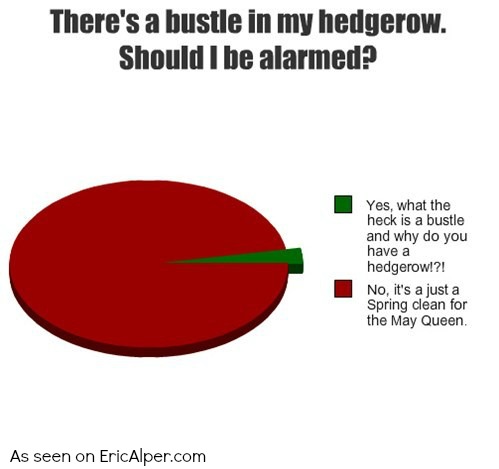
“If there’s a bustle in your hedgerow, don’t be alarmed now,
It’s just a spring clean for the May queen.
Yes, there are two paths you can go by, but in the long run
There’s still time to change the road you’re on.
And it makes me wonder.”

stairway

It makes us all wonder. But that is the point – at least as far as my definition of hedgerow is concerned. It’s a place to wander and wonder.

An actual hedgerow is a stretch of semi-wild trees or shrubbery, (perhaps with a path!) which creates borders between fields, a place where foxes can live, blackberries can grow, and children can disappear for the day and come home happy, dirty, and still wondering. It’s right next to cultivated fields, so it’s easily accessible from the places where you normally work, the places you keep much tidier but spending any time tending and exploring the hedgerows only brings you surprises. A handful of edible mushrooms, priceless, not something you expected.

When I was a boy we had a creek, woods, places to while away the summer days, unplugged. We could spend an afternoon exploring up the creek, farther each time, we could spend hours building a hut. The best hut was built after workmen with bulldozers cleared a field for a new blueberry patch. They pushed dozens of trees and brush up against the side of the field and into the woods, and on the back side, we found a hollow. We took actual tools, bailer twine, spent hours building sides and a door, cutting and lashing, log cabin style, and camped out. We were so unplugged, so far away that we couldn’t be called for dinner, or to take out the trash – and we liked it that way.

We never felt guilty about taking the time to do this. We saw it as a normal way to spend the day.

In the hedgerow you may work, but it’s a playful work. You may write an essay and decide it doesn’t fit your book. You may run extra experiments for fun and discover something you weren’t even researching.

I believe that a motivational listener needs to not only have margins and Sabbath but also must explore a hedgerow now and then. Perhaps even often. We gain perspective just by looking at the world differently. We follow a trail just to see where it goes; and if it goes nowhere, or to the dump, where we might find some piece of junk we discovered we need in our pocket, so much the better. When we’re used to exploring hedgerows for ourselves, we’re ready to guide others in that same quest.

When we listen, we listen for the interesting bits. Not the parts where people are regularly cultivating a field. When I coach, the areas where my client has neatly plowed and planted, the parts of their lives that are in order, are not the places where we can discover anything new. We won’t find the interesting rock walls to climb, the juicy blackberries to pick, and we won’t spot a skunk in their neatly plowed fields. But if there’s a bustle in the hedgerow, I follow it.

How do I schedule time to be in the hedgerow?

The main tactic to make space for this is to loosen up your schedule. I just re-took the MBTI personality test and discovered that I’m borderline between Judger  or “J” (the type of person who likes to have a strict schedule) and the Perceiver, i.e. “P” (the one who likes to keep their options open). I believe that Personality Type isn’t static. I used to be a pretty intense J, but it’s the P who likes to make up stories. It’s the P who has empty space in their schedule, and likes to keep it that way. In other words, partly because I learned to coach and to write fiction between 2009 and 2014 while being under-self-employed meant that I naturally had a lot more room in my schedule than I used to, and I had to adapt to that lifestyle, which meant becoming comfortable again in the hedgerows.

I can’t tell you excactly how to loosen up your schedule. That’s a problem for you on an individual level. (If you’re having trouble doing it on your own, you’re a candidate for a wax job). After all, it was somewhat forced on me by a variety of circumstances. One thing I can say for sure is that without it, I wouldn’t be the motivational listener and storyteller that I am today, certainly not with the same quality and excellence.

I think this is something that business coaches often don’t really find their way into. They move from high-powered executive positions to hard-charging coaches who are constantly selling and networking, rarely with time themselves in the hedgerows. This makes it difficult for them to invite people into the hedgerow. For those of us in a busy Western world, or in a busy business environment generally (and they tell me now that things are even busier in Seoul and Singapore than they are in the USA). But business people don’t need your help with more cultivation. They need help exploring hedgerows.